
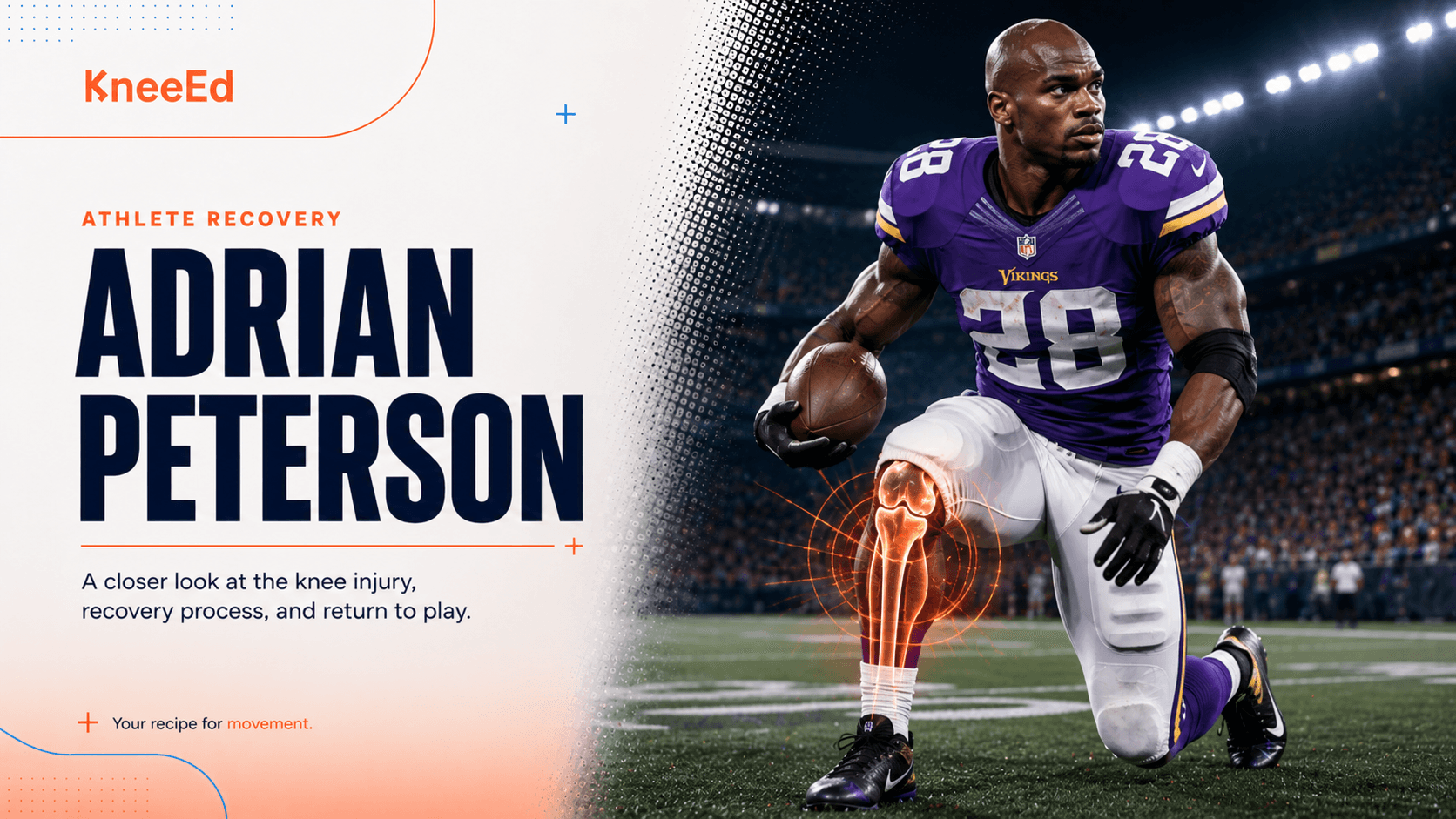
On Christmas Eve 2011, at FedEx Field, Adrian Peterson took a handoff and planted his left foot to cut. Washington safety DeJon Gomes came in low and drove a hit into the side of the knee while the foot was still stuck in the turf. The joint folded inward and twisted. Players nearby later said they heard three distinct pops. Peterson did not get up the way he usually did. By the time the medical staff reached him, two of the four major ligaments in that knee, the anterior cruciate and the medial collateral, were gone, and the medial meniscus had torn with them.
He was 26 years old, in the middle of one of the most physically punishing careers the sport has produced. The standard timeline for a running back after a torn ACL is a lost year and, often, a lost step. Peterson lost neither. Six days after the injury he was on an operating table in Birmingham. Eight and a half months after that he was starting on opening day. And then he did something no one returning from a reconstructed knee had ever done.
He ran for 2,097 yards the very next season, the second-most in a single year in NFL history, nine yards short of the all-time record, on a knee that had been rebuilt the winter before. Then he won MVP.
His recovery usually gets told as a story about toughness. The more useful and more honest version is about the actual protocol behind it, the biology it had to respect, and a man so impatient with his own rehabilitation that the people running it could barely hold him back.
The protocol: six phases, eight months, and one impatient patient
The first decision that shaped everything was speed of surgery. Peterson tore the knee on December 24, 2011. On December 30, six days later, he was in Birmingham, Alabama, with Dr. James Andrews, the orthopedic surgeon whose name has been attached to more famous athletes' joints than almost anyone alive. Andrews reconstructed the torn ACL and addressed the MCL. Operating that quickly is not always the textbook call, because a knee that is still hot and swollen can stiffen after surgery, but in Peterson's case the timing started a clock that the rest of the program was built to run against.
The program itself belonged to Eric Sugarman, the Minnesota Vikings head athletic trainer, who built a six-phase rehabilitation plan around an eight-month target. That target matters. Eight months is aggressive for an ACL, and even more so for an ACL with a torn MCL alongside it, and Sugarman was explicit that it was a ceiling on ambition, not a floor to beat. He framed it bluntly.
Thereweresixphasestorecovery,andthetimetablewaseightmonths.Tothinkthatitwillhappenbeforethattimeframeisunrealisticandprobablynotsafe.
It is worth sitting with that quote, because it is the opposite of how the comeback is usually remembered. The people closest to it were not chasing a record-setting fast return. They were trying to hold the line at eight months against an athlete who wanted to beat it. The phases below are the scaffolding they used to do that, mapped to the standard logic of ACL rehabilitation.
What the six phases actually do
- Restore (roughly weeks 0 to 4). Calm the joint down. Get the swelling out, win back full knee extension first, and switch the quadriceps back on, because the quad shuts down reflexively after surgery and will not return on its own. Nothing heroic happens here, and trying to skip it is how knees stiffen.
- Regain (roughly months 2 to 3). Move from the table to standing. Closed-chain work, weight through the foot, and a relentless focus on quadriceps symmetry, closing the strength gap between the surgical leg and the healthy one.
- Reload (roughly months 4 to 6). Controlled resistance training, single-leg stability work, and the first careful linear running. This window is also when the graft is biologically at its weakest, which is exactly why the running stays straight-ahead and the loading stays controlled.
- Return (roughly months 6 to 9 and beyond). Sport-specific agility, deceleration, and the part that matters most for a football player: unanticipated movement, reacting to a stimulus rather than running a pre-planned drill, because that is what the field actually demands.
Peterson did not run all of this inside the Vikings facility. He spent part of his offseason rehab in Houston working with physical therapist Russ Paine, a clinician endorsed by Andrews himself, doing daily bike work, upper-body conditioning, plyometrics, and flexibility and range-of-motion work for the left knee. Back in Minnesota, strength and conditioning coach Tom Kanavy ran the field side of it: heavy ropes, dumbbells, and sprints, the punishing late-stage conditioning that started ramping up around the July 2012 training camp. The common thread across all three settings was daily frequency. This was not three big sessions a week. It was something every day, which is the single most replicable idea in the entire story for a general reader.
The week the trainer nearly broke
The most revealing moment of the rehab was not a milestone. It was a conflict. Around week 10, on the leg press, Peterson decided the prescribed weight was an insult.
Thisistoolight.I'mnotgettinganyworkdone.Ineedyoutobumpthisweightup.
Sugarman's own description of managing that intensity has become the quiet punchline of the whole comeback: he said he thought he was going to have a nervous breakdown. That tension is the real engine of the story. The athlete's job, in his mind, was to push against every boundary. The trainer's job was to let just enough of that energy through to accelerate recovery while protecting a graft that could not feel how strong it was not yet. The eight-and-a-half-month return happened because both of those forces were operating at once, not because either one won.
The injury: two ligaments, one planted foot, the unhappy triad
To understand the recovery you have to understand exactly what tore, because the diagnosis dictated the whole plan. This was not an isolated ACL, the single-ligament tear most fans picture. Peterson sustained a combined injury across multiple structures, the classic pattern clinicians call the unhappy triad: the ACL, the MCL, and the medial meniscus, all torn in one event.
The mechanism was textbook for that pattern. Peterson's left foot was planted and fixed in the turf when Gomes hit the outside of the knee low. Three things happened in the same instant. A valgus force drove the knee inward, the direction it is not built to bend. The femur rotated internally on the tibia with the knee slightly flexed. And because the foot could not give way, the joint had nowhere to send the energy except into its own restraints. They failed in order.
What each structure was doing, and why it tore
- The MCL is the primary restraint against valgus, the inward-bending force, when the knee is flexed. It takes the brunt of a low hit to the outside of the joint, and it is typically the first to go in this pattern.
- The ACL is the primary stabilizer against the shinbone sliding forward and against rotation. With the foot planted and the femur twisting internally, it was loaded in exactly the way it is least able to survive, and it ruptured completely.
- The medial meniscus, the crescent of cartilage that absorbs shock and helps distribute load, was caught in the compression and rotation between the bone surfaces and tore as well, compounding the instability by removing a shock absorber.
Combined ACL and MCL tears are not rare. They occur in something like 20 to 38 percent of ACL injuries, which is to say a meaningful fraction of all of them. But the combination changes the math. An isolated ACL tear leaves the rest of the knee's architecture intact to support the rebuild. A combined tear takes out the central stabilizer and the primary medial restraint at the same time, and the meniscus damage removes a cushion the joint relies on for the rest of its life.
Why the MCL and the ACL get treated differently
Here is the part that surprises people. The two torn ligaments did not get the same treatment, because they do not heal the same way. The MCL has a rich blood supply and a strong capacity to heal on its own. In most combined injuries it is managed conservatively: rest, ice, a hinged brace that allows the knee to bend and straighten while resisting the inward valgus stress, and progressive physical therapy, with roughly six to eight weeks of protected healing before aggressive strengthening begins. Distal MCL tears, lower toward the shinbone, tend to heal faster than proximal ones near the thigh.
The ACL is the opposite. It sits inside the joint bathed in fluid, with a poor blood supply, and a torn ACL essentially does not heal itself into a functional ligament. That is why it gets reconstructed surgically and the MCL usually does not. Peterson was 26 when this happened, which sat firmly on the favorable side for healing, and he wore the protective bracing the medial side needed. The treatment plan that followed was, in effect, two plans braided together: a surgical reconstruction of the ACL running on the long graft-maturation clock, and a conservative rehabilitation of the MCL running on a faster healing clock underneath it.
The injury, stated plainly. This was a combined multi-structure tear, not an isolated ligament, and the two clocks ran in parallel.
3
Structures involved in the unhappy-triad pattern: ACL, MCL, and medial meniscus, torn in a single planted-foot valgus event.
6 days
From the Christmas Eve injury to Dr. James Andrews's reconstruction in Birmingham on December 30, 2011.
26
Peterson's age at injury. Younger age sits on the favorable side of the variables that govern ligament healing.
6-8 wk
Typical protected-healing window for a conservatively managed MCL before aggressive strengthening begins.
Graft science: why the new ligament is weakest exactly when you feel strong
Reconstructing an ACL does not mean stitching the torn ligament back together. It means replacing it. A surgeon takes a tendon, often from the patient's own hamstring or patellar tendon, or from donor tissue, drills it into the bone where the ACL used to anchor, and fixes it in place. What goes in is a tendon. What has to come out, biologically, months later, is a ligament. That transformation has a name: ligamentization.
Ligamentization is slow, and it is the single most important reason timelines exist. The grafted tendon does not arrive as a finished ligament. It has to be remodeled cell by cell, and the process runs anywhere from 6 to 24 months. The early stage, roughly weeks 4 to 12, is a proliferative phase: the graft develops a new blood supply and lays down a disorganized, weaker form of collagen. Only later, from about week 12 onward, does true ligamentization take over, replacing that disorganized matrix with stronger, better-aligned collagen.
Which leads to the most counterintuitive and most important fact in all of ACL recovery. The graft is at its biologically weakest somewhere between three and six months after surgery, the very window in which an athlete starts to feel terrific, moves well, and wants to test the knee. The leg looks strong. The graft is in the middle of being torn down and rebuilt. This is the gap that every cautious phase in Sugarman's plan was designed to bridge: keeping load on the knee while keeping it in the directions and magnitudes the immature graft could survive.
Mybodyhasalwaysbeenabletorebuildandrecoverfast.Ilearnedthataboutmybodythrough28years.
Straight ahead before sideways: the scheme as a clinical tool
One of the smartest, least-discussed parts of Peterson's return was not in the weight room. It was in the playbook. When he came back, the Vikings leaned on a between-the-tackles, straight-ahead running scheme, and there is a real biomechanical reason that protected the knee. The ligaments Peterson tore are loaded most dangerously by valgus and rotational forces, the inward bend and the twist. Straight-line running, downhill between the offensive guards, minimizes exactly those forces. Cutting, planting, and lateral change of direction maximize them. Exposure to side-cut situations is precisely where re-injury risk climbs.
In other words, the offense let Peterson load the knee heavily in the one direction it tolerated best long before it asked him to load it in the directions it tolerated least. This is the same principle a good rehab uses on a smaller scale: linear running returns well before cutting, deceleration is trained before reaction, and high-load pivoting is the last thing restored, not the first. Peterson got to run violently downhill for an entire season precisely because the scheme kept the most dangerous vectors off a knee that, at the cellular level, was still finishing its rebuild.
The criteria that should clear a knee, not the calendar
This is also where the honest version of return-to-sport lives. The best practice is not to clear a knee because a date on the calendar arrived. It is to clear it because the knee passed objective tests. The standard battery looks for things like strength symmetry between the two legs at 97 to 100 percent, a hop-test battery showing greater than 90 percent symmetry and ideally above 97, range of motion matching the other side within about 5 degrees, and balanced reach on a Y-balance test. The point of all of it is the same: prove the knee is ready with measurements, because the athlete's own confidence runs ahead of the biology almost every time.
The season that should not have happened
Peterson returned in Week 1 on September 9, 2012, roughly 260 days after surgery. He ran for 84 yards and two touchdowns and the Vikings beat Jacksonville. That alone would have been a success story, a starter back on opening day from a combined ACL and MCL tear. What came next belonged to a different category entirely.
He got better as the season went on, not worse, which is the inverse of what a healing knee under accumulating NFL punishment is supposed to do. The arc peaked in December. In that single month Peterson ran for 861 yards, an NFL record for rushing yards in a calendar month that still stands, and was named NFC Offensive Player of the Month. He finished the year with 2,097 rushing yards on 348 carries, nine yards short of Eric Dickerson's single-season record from 1984, and was named NFL MVP, the first non-quarterback to win it in six seasons and, as of 2025, the most recent.
Dec 24, 2011
The injury
Planted left foot, low hit from DeJon Gomes, valgus and rotation. ACL and MCL torn, medial meniscus with them. Three pops heard on the field.
Dec 30, 2011
Surgery, six days later
Dr. James Andrews reconstructs the ACL in Birmingham and addresses the MCL. Eric Sugarman's six-phase, eight-month program begins.
Spring 2012
Daily work, two cities
Houston phase with PT Russ Paine: daily bike, plyometrics, range of motion. The week-10 leg-press standoff with Sugarman.
July 2012
The field returns
Tom Kanavy ramps the punishing conditioning at training camp: ropes, dumbbells, sprints. Late-stage, sport-specific load.
Sep 9, 2012
Week 1, starting
About 260 days post-surgery. 84 yards and two touchdowns against Jacksonville in a Vikings win.
Dec 2012
861 yards in a month, then MVP
A single-month rushing record that still stands, a 2,097-yard season nine short of the all-time mark, and the MVP award.
Peterson has been clear-eyed about what that season was and what it asked of everyone watching it. He did not pretend it was ordinary.
IunderstandIputthebarhigh.Iputintheworktoaccelerateit.Idon'tknowiftoomanyguyscandowhatIdid.
Honest expectations: why his timeline is an outlier, not a target
Everything above is true, and it would be a disservice to leave a reader thinking eight and a half months is the number to chase. It is not. Peterson's outcome sits at the extreme outlier end of what is possible, and several specific advantages stacked up behind it that almost no one else has all at once.
- Genetics he himself flagged as unusual. He has said plainly that his body has always rebuilt and recovered fast, and recovery capacity genuinely varies between people in ways no amount of effort overrides.
- Elite, professional-grade athleticism: a baseline of strength, conditioning, and fast-twitch capacity that a recreational athlete simply does not start from.
- Unlimited resources and full-time access. He had a world-renowned surgeon, a dedicated head athletic trainer, an endorsed physical therapist, and nothing to do all day but recover.
- A scheme built to protect the knee, letting him load it heavily only in the safest direction for an entire season.
- A mental relentlessness that pushed against medical limits, balanced by a team whose job was to push back.
Now the numbers that should actually anchor a general reader's expectations. Across studies, only about 55 percent of elite athletes return to their prior competitive level within one to two years of ACL reconstruction, and the typical return window is 9 to 18 months, not 8. The reason that window exists is risk, and the risk is steep. Returning to sport before nine months post-reconstruction has been associated with roughly a sevenfold increase in re-injury risk. Put the other way, each additional month of delayed return, up to nine months, has been associated with a 51 percent reduction in the odds of re-tear. The calendar is not bureaucracy. It is the graft's biology made into a date.
The honest baseline for a general reader, not the highlight reel. These are the numbers to anchor expectations to.
9-18
Typical months to full return to sport after ACL reconstruction. Peterson's roughly 8.5 months is the fast outlier, not the norm.
55%
Share of elite athletes who return to their prior competitive level within one to two years. Most knees are not Peterson's knee.
7x
Approximate increase in re-injury risk when returning to sport before nine months post-reconstruction.
51%
Reduction in re-tear odds for each additional month of delayed return, up to the nine-month mark.
The 2016 knee, and the price of pushing
There is a coda that complicates the legend in a useful way. Years later, in Week 2 of the 2016 season against Green Bay, Peterson tore roughly 90 percent of the meniscus in that same knee. He attacked the recovery the way he always had, returning by Week 14, and he was open about what that acceleration cost him to fund.
Iwasdoingthiseveryweek,spending$10,000aweektogetbackoutthereinthehopeofusmakingittotheplayoffs.
Ten thousand dollars a week, by his account, went toward blood-flow-restriction training, a hyperbaric chamber, stem-cell work, and ozone therapy. Set aside whether each of those is proven. The point is the resource gap. The recovery model that produced the legend is, in part, a model that costs more per week than most people's rehab costs in total. And the 2016 meniscus tear is itself a quiet lesson: a knee that has been reconstructed and pushed remains vulnerable for years, and the meniscus, already injured in 2011, is exactly the structure that protects the joint surface over a lifetime. Pushing through is not free, even for him.
What to take from this, if you are the one rehabbing a knee
The right way to admire Peterson's comeback is to copy the parts that transfer and ignore the parts that do not. What transfers: the daily frequency, the patience to win full extension and quad control before anything fancy, the discipline of loading the knee in safe directions before risky ones, and the willingness to be measured by objective tests rather than how the leg happens to feel. What does not transfer: the eight-and-a-half-month clock, the leg-press bravado, and the assumption that more aggression always means faster healing. For a non-elite person, realistic return to sport is 9 to 12 months minimum with documented clearance, and return to full activity often runs 12 to 18 months.
There is a psychological dimension that deserves the same honesty as the physical one. Fear of re-injury after a serious knee surgery is common, rational, and not a character flaw, and the re-injury rate, around 15 percent on average, means that fear is responding to something real. The goal is not to bulldoze it the way Peterson bulldozed his leg-press numbers. The goal is to retire it with evidence: strength symmetry, hop scores, and a clinician's clearance that say the knee has earned the next step. Peterson himself drew the boundary as well as anyone could.
Iwasbetter,andIknewjusttheworkalonewouldbehardforanybodytoduplicate.SoIsetthebarhigh.
That is the whole story in one line. The bar he set was real, and it was his. The honest coaching that follows from it is not to chase his number. It is to respect the biology he had the genetics to outrun, follow evidence-based timelines, prioritize strength, range of motion, and balance testing over arbitrary deadlines, and accept that the right comeback is the one your own knee passes, not the one a highlight reel sold you.
References
- 01ESPN · Eric Sugarman and the rehab behind Adrian Peterson's 2012 return · Accessed June 2026
- 02Bleacher Report · Breaking down Adrian Peterson's journey from ACL surgery to MVP season · Accessed June 2026
- 03Bleacher Report · Adrian Peterson's ACL tear: a closer look at his injury and recovery · Accessed June 2026
- 04CBS News New York · Injury breakdown: Adrian Peterson and the unhappy triad · Accessed June 2026
- 05Star Tribune · Chart: Adrian Peterson's 2012 timeline · Accessed June 2026
- 06Hospital for Special Surgery · ACL and MCL tear: differences and combination injuries · Accessed June 2026
- 07National Library of Medicine (PMC) · ACL graft healing and ligamentization: the biology of recovery · Accessed June 2026
- 08MobilityFit · Why return to sport at nine months after ACL repair versus six · Accessed June 2026
- 09NFL.com · Adrian Peterson on his 2016 recovery: I spent ten thousand dollars a week · Accessed June 2026
- 10Yahoo Sports · Adrian Peterson on his recovery: I understand I put the bar high · Accessed June 2026