
At his peak, Michael Phelps swam between 85,000 and 90,000 meters a week. That is more than fifty miles, two arms, two shoulders, the same overhead stroke repeated until each shoulder turned over roughly 16,000 times a week and well over 800,000 times a year. No joint in sport is asked to do what a butterfly specialist's shoulder is asked to do, and Phelps did it for sixteen years across five Olympic Games.
He retired the most decorated Olympian in history, with 28 medals, 23 of them gold, more than most countries have won in the entire history of the modern Games.
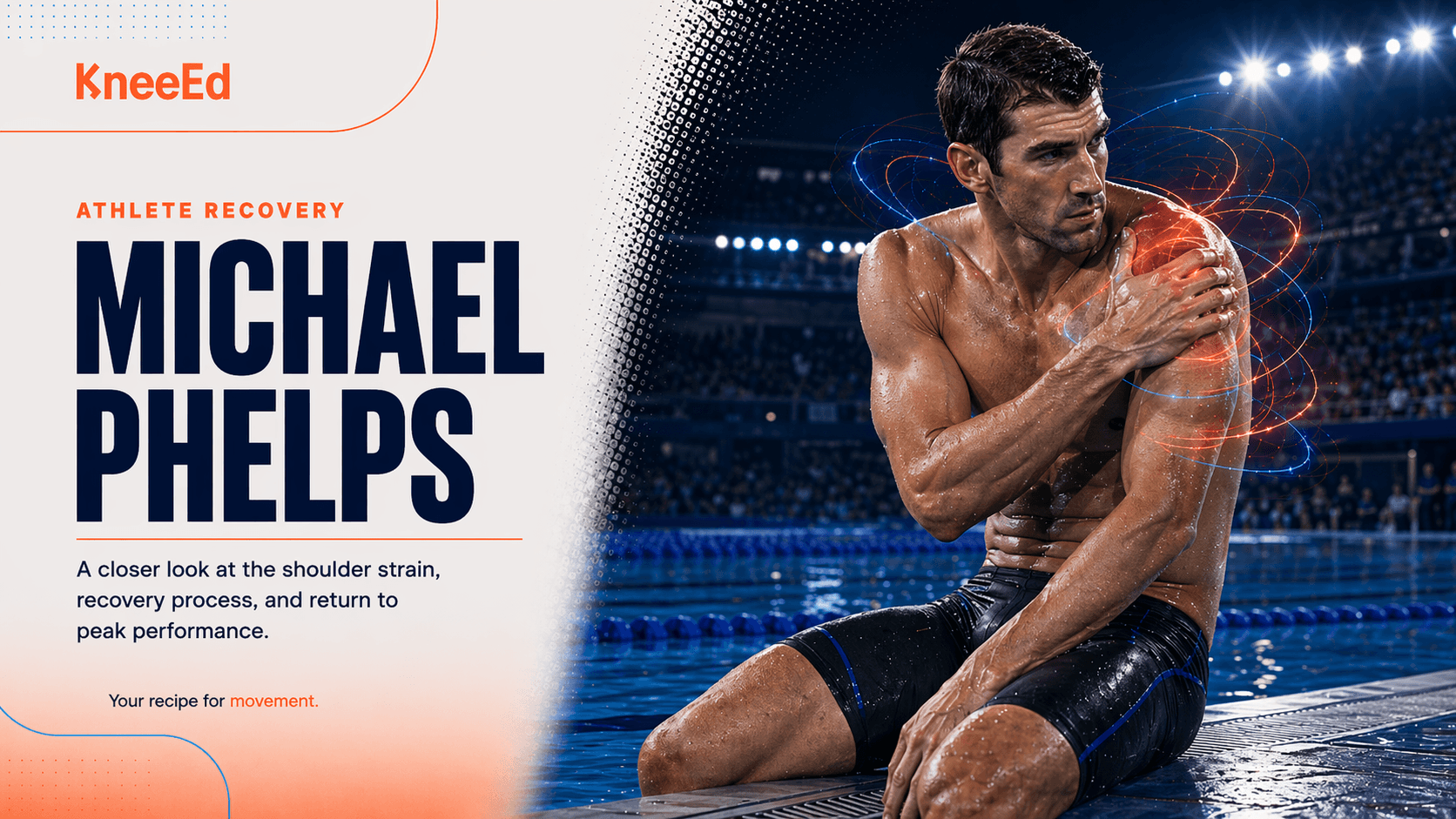
That is the record everyone knows. But the comeback this story is actually about is not in the water. After the 2012 Olympics, Phelps sat alone in a bedroom for days at a time, not eating, barely sleeping, by his own account not wanting to be alive. The shoulder is the body part on the hero image. The thing he says saved his life is harder to see, and it is the more important half of the story.
Why a swimmer's shoulder breaks down
The shoulder is the most mobile joint in the body and, as a direct consequence, the least stable. The ball of the upper arm sits against a shallow socket and is held in place almost entirely by soft tissue: the four rotator cuff muscles and the muscles that position the shoulder blade. That arrangement is brilliant for reach and rotation. It is fragile under repetition. And competitive swimming is repetition in its purest form.
A swimmer at the elite level covers around 14,000 meters a day. Every stroke asks the shoulder to internally rotate at the catch, drive through a powerful pull, and recover overhead, and it does this on both sides, thousands of times per session, six or seven days a week. Research on collegiate swimmers found that 47 percent experience shoulder pain that persists for three or more weeks during a season. Pain is not the exception in this sport. It is close to the baseline.
The imbalance that builds the iconic torso, and the problem
The same training that gave Phelps his famous V-shaped physique is what sets the shoulder up to fail. Years of pulling hypertrophy the chest (pectoralis major) and the lats (latissimus dorsi), the big anterior muscles that produce power. Meanwhile the smaller muscles on the back of the shoulder, the ones that stabilize the shoulder blade, the rhomboids and middle trapezius, get relatively lengthened and weak. The chest tightens and shortens, the shoulders round forward, and a classic swimmer's posture sets in: forward head, rounded shoulders, a flat lower back.
That posture is not just cosmetic. When the shoulders round forward, the shoulder blade can no longer rotate properly to clear the arm overhead. The space under the bony tip of the shoulder, the subacromial space, narrows. And it is precisely at the hand's entry into the water, arm overhead, that the space is tightest.
The result is a slow, mechanical grind: the supraspinatus tendon at the top of the rotator cuff repeatedly contacts the underside of the acromion, and inflammation of that tendon is the leading cause of shoulder pain in swimmers.
This is impingement, and it compounds. As the shoulder starts to hurt, the athlete unconsciously changes the stroke to avoid the painful position: a different hand-entry angle, a shallower pull, more reliance on the big chest and lat muscles to do what the fatigued rotator cuff can no longer do cleanly. Those compensations degrade the mechanics further, which loads the cuff in worse positions, which produces more pain. Repeated 800,000 times a year, a small imbalance becomes a chronic injury. For Phelps, the risk factors stacked: training volume above even the elite average, an event specialty (butterfly and individual medley) that demands maximal shoulder rotation, and sixteen years of it.
It is worth pausing on why butterfly in particular is so punishing. In freestyle and backstroke the arms alternate, so one shoulder is recovering while the other is pulling. Butterfly drives both arms over the water at once, with the chest and the front of the shoulders generating the entire stroke, and the individual medley forces a swimmer to train all four strokes, which means there is no event in which the shoulder gets a relative rest. Phelps's signature races were precisely the ones that loaded the most fragile part of the most fragile joint, hardest, with the least built-in recovery. A career built on the 200m butterfly is a career built on the exact mechanism that produces swimmer's shoulder.
The prehab that kept him in the water
Phelps trained under one coach, Bob Bowman, from the age of eleven. Bowman, who would go on to be named head coach of the 2016 United States Olympic men's team, understood that managing the shoulder over a long career is not about one rehab block after an injury. It is about a permanent culture of dryland work, postural correction, and intelligent volume, run alongside the swimming, year after year. The evidence base agrees with the instinct.
What the science says actually works
Two findings anchor the preventive approach for swimmers, and both are unglamorous and effective.
- A 12-week program of twice-weekly sessions, using free weights or elastic bands to target the rotator cuff and the serratus anterior (the muscle that rotates the shoulder blade upward as the arm raises), can minimize the progressive shoulder rotational imbalance that swimming builds.
- An 8-week program combining stretching and strengthening for forward-head and rounded-shoulder posture produces measurable reduction in that posture and in perceived shoulder dysfunction. You can move the structure back toward balance; it does not have to keep drifting forward.
- The targets are specific: the external rotators (infraspinatus, teres minor) to counter the internal-rotation bias of swimming, the subscapularis for internal-rotation stability, and the serratus anterior for upward scapular rotation. Generic shoulder work misses them.
The dryland protocol, in practice
Bowman's dryland work for Phelps mapped onto exactly that mechanism. It was not bodybuilding. It was built to strengthen the stabilizers the stroke neglects and to spread the load off a single plane of stress.
- Medicine ball work (a Bowman-standard routine) to build rotator cuff and scapular-stabilizer strength through dynamic, throwing-pattern movements.
- Plyometrics, including hanging leg raises and band-resisted squat jumps, to develop the dynamic stability the shoulder needs during the rapid acceleration of the pull.
- Pull-ups and bodyweight strength work, emphasizing the posterior chain to balance the overdeveloped front of the shoulder.
- Elastic-band training aimed specifically at the external rotators, the muscles swimming systematically under-trains.
- Stretching of the pectoralis minor and latissimus dorsi to release the front of the shoulder and let the shoulder blade sit back where it belongs.
- Cross-training such as rowing and cycling, to prevent the body from adapting to a single repetitive stress and to keep conditioning without adding shoulder revolutions.
When Phelps came back in 2014 at age twenty-nine and thirty, Bowman made one more change that matters more than any single exercise. He cut the volume. The peak of 85,000 to 90,000 meters a week came down to a sustainable 50,000 to 60,000, structured in three-day cycles (endurance, then endurance plus speed, then speed work) with more recovery between sessions, four to five dryland sessions a week, and increased use of ice baths. The shoulder of a thirty-year-old who has already logged sixteen years cannot absorb the volume of a twenty-year-old's. He trained less, recovered more, and swam faster.
Modified volume, quality-focused work: the 2015 National Championships proved it.
1:52.94
His 200m butterfly at 2015 Nationals, his fastest since his 2009 world record, after cutting weekly volume by roughly a third.
50.45
His 100m butterfly that summer, the fastest he had swum in six years.
1:54.75
His 200m individual medley, his fastest in four years.
30
His age, swimming those times on the reduced, recovery-first program Bowman built for an aging shoulder.
The injury the records never showed
Here is where the story turns, because the comeback that defined Phelps did not happen in a weight room. After the 2012 London Olympics, where he won four golds and two silvers and seemed to have everything a person could win, something gave way that no dryland program could reach.
Ijustdidn'twanttobealive.Itwasareally,really,reallycrazytimeforme.
He has described sitting in his bedroom for three to five days at a stretch, not eating, barely sleeping. It happened after competition, more than once, which is the tell. This was not the ordinary low after a big event. It was a recurring pattern, which is what clinical depression looks like, and it had been building under the surface for a long time.
Why winning everything did not fix it
Phelps entered competitive swimming at age seven. For two decades, his identity, his daily structure, his relationships, and his entire sense of self-worth were organized around one thing: swimming performance. Psychologists call this identity foreclosure, when a person's whole self is fused to a single role. It is common in elite athletes, and it carries a specific danger. When the goals are finally achieved, the organizing principle of the self collapses, and whatever was buried underneath comes up.
Underneath, in Phelps's case, was an unresolved wound. His parents divorced in 1994, when he was nine, and he became estranged from his father, Fred. For most of his career he compartmentalized that pain and poured himself into the next goal. The achievements masked the wound; they never healed it. So when 2012 removed the forward-focused structure that had organized everything, the accumulated grief, the abandonment, the decades of suppression arrived all at once, into a person who had no framework for self-worth outside the pool.
It is the crucial insight of his advocacy, and it is counterintuitive: he had won 28 Olympic medals and was still depressed, which reveals that depression is independent of external success. No medal count fixes it.
The breaking point
In September 2014, Phelps was arrested for driving under the influence, his second such arrest. USA Swimming suspended him for six months. The public image of the invincible athlete cracked. And then, in his own account, he locked himself in his bedroom for days and contemplated taking his own life.
Ididn'twanttobeinthesportanymore.Ididn'twanttobealiveanymore.
It is worth being honest about the role the arrest played. It was a genuine failure with real consequences, legal and public. It was also the external crisis that finally forced him to stop compartmentalizing and accept help. Without it, by his own telling, he might have kept burying the pain and pushing forward. The DUI is not the redemptive part of the story. What he did next is.
What recovery actually looked like
In October 2014, Phelps checked into The Meadows, a residential treatment facility in Wickenburg, Arizona, for a 45-day inpatient program. Not a weekend, not an outpatient check-in. Forty-five days, away from phones and internet, in a structured therapeutic environment. The most decorated Olympian in history put the comeback on hold to do the harder work first.
The components of the program
The protocol he went through maps onto what the evidence supports for severe depression with suicidal ideation, and the sequence matters.
- Structured containment first. A 24-hour therapeutic environment for an acute suicidal crisis, with access to alcohol removed entirely, a professional mental-health team, and a peer community of others in recovery.
- Cognitive behavioral therapy, daily, to identify the dysfunctional thought patterns, in his case the belief that he was only a swimmer and not a person, and to build the skill of naming and regulating emotions rather than suppressing them.
- Family-systems work. During the program's family week, he reconciled with his estranged father, addressing roughly twenty years of abandonment that had sat unresolved since the 1994 divorce. This was the attachment wound underneath the depression, and treatment went straight at it.
- Continuation care after discharge. Ongoing individual therapy in Maryland, phone therapy sessions coordinated around his training, participation in a 12-step program, and a rebuilt support structure that later included his wife, Nicole.
The order of those four steps is not arbitrary. You cannot do the deep emotional work of CBT or family reconciliation while the body is still in acute crisis, which is why containment comes first. And the work does not end at discharge, which is why continuation care is its own step rather than an afterthought. The 45 days bought stability; the years of therapy after them are what kept it. This is the difference between a treatment event and a recovery, and it is the single most copyable thing in Phelps's story for anyone facing the same fight without his resources.
The breakthrough he describes is not about swimming faster. It is about becoming a person.
Istartedfeelinglikeaperson.IguessIcouldlovemyselfandlikewhoIsaw.IthinkforalongtimeIlookedatmyselfasaswimmerandnotahuman.
Then, and only then, the swimming
This is the part people get backward. Phelps did not return to swimming to fix his mental health. He got treatment first, reached stability, and then made a free choice about the pool. He relocated his training base to Arizona in early 2015, integrated his therapy into his daily schedule, and committed to abstinence from alcohol.
Haven'thadasinglesipandwillnothaveasip.
The purpose of the swimming changed. It was no longer training for history or for anyone's expectations. It was something he wanted to do, on his own terms. At the 2016 Rio Olympics, at age thirty-one, he won five gold medals (200m butterfly, 100m butterfly, 200m individual medley, and both freestyle relays) and a silver in the 100m freestyle, and was chosen to carry the United States flag at the opening ceremony. The medals were real. But on his own account, they are the secondary story.
IamextremelythankfulthatIdidnottakemylife.
What this actually means for your recovery
Phelps is an outlier in every dimension: the volume, the talent, the coaching, the resources, the team around him. His timelines are not your timelines, and his elite return is not a template to copy literally. But the principles underneath both halves of his story transfer cleanly, and they are worth stating plainly.
On the shoulder
- Back does not mean the same. After sixteen years of elite training, the structural changes in a swimmer's rotator cuff (micro-tears, scarring, degenerative change) do not get cured. They get managed. The honest goal is a shoulder that works well and without pain, not a shoulder that is mechanically new.
- Prevention is ongoing work, not a one-time block. The 12-week and 8-week programs are effective only if you actually keep doing the rotator-cuff, scapular, and postural work. The most common failure mode is doing it for a few weeks, feeling better, and quitting, which leads straight back to the same impingement.
- Volume management is not weakness; it is the strategy. Phelps swam faster on a third less volume because the reduced load let an aging shoulder recover and adapt. For a recreational athlete, the equivalent is honest: less total volume, more quality, real recovery between hard sessions.
- A realistic shape: pain control in the first few weeks, return to sport-specific work over roughly twelve weeks if the preventive protocol is strict, and full pain-free force development over six to twelve months for serious athletes, with lifelong maintenance after that. Compress that timeline and you reinjure.
On the part that matters more
The deepest honesty in Phelps's story is not about the shoulder at all. It is one sentence he repeats, and it is clinically accurate, not pessimistic.
Mydepressionandmyanxietyisnevergoingtojustdisappear.It'salwaysgoingtobeapartofme.
Major depression is a chronic condition with high recurrence. There is no cure to wait for; there is management, with tools, support, and sometimes medication. Phelps still has hard days. He has spoken about struggling weekly, or from time to time, even after Rio. The difference is not that the depression left. It is that he now has the skills and the people to move through a bad day without it becoming an acute crisis. That is what recovery from depression looks like in real life: not the symptoms vanishing, but a person who can carry them and still live a full life.
This reframes what the Rio 2016 medals actually represent. The five golds were not proof that Phelps had beaten his depression. He was clear that the depression was permanent. The medals were proof of something quieter and more durable: that a person can live with a chronic condition and still pursue the things they value. In clinical terms, that is the logic of acceptance and commitment, living alongside the condition while moving toward what matters, rather than waiting to be cured before allowing yourself to begin. The comeback was never evidence that the illness was gone. It was evidence that he could build a life that did not depend on it being gone.
And the sequence is the lesson for anyone facing both a physical injury and something heavier underneath. Phelps did not rush back to sport to feel better. He treated the mental health first, reached stability, and only then chose whether sport still fit his life. If you wait for depression to fully resolve before returning to anything, you may wait forever, because that is not how the condition works. The direction is the other way: get the help, build the stability, then decide. The 45 days were not negotiable. The medals could wait.
The record book remembers 23 golds. Phelps remembers something else. The shoulder was a problem he and Bowman solved with patient, unglamorous, repeated work, the same way most shoulders get solved. The deeper injury took a different kind of courage: stopping, asking for help, and rebuilding the person underneath the swimmer. He has been clear about which comeback he is proudest of. It is the one that kept him alive.
References
- 01Healthline · Michael Phelps: 'My Depression and Anxiety Is Never Going to Just Disappear' · Accessed June 2026
- 02CNN · Michael Phelps: 'I am extremely thankful that I did not take my life' · Accessed June 2026
- 03E! Online · Michael Phelps Recalls Depression Battle: 'I Just Didn't Want to Be Alive' · Accessed June 2026
- 04Sports Illustrated · Michael Phelps: the comeback after rehab and the road to Rio 2016 · Accessed June 2026
- 05FHE Health · Michael Phelps and depression: the story behind the comeback · Accessed June 2026
- 06The Mighty · Michael Phelps on suicidal thoughts, therapy, and asking for help · Accessed June 2026
- 07Learn Muscles (Joseph Muscolino) · Michael Phelps, forward head posture, and swimmer's shoulder · Accessed June 2026
- 08Swimming World Magazine · The early training that led Michael Phelps and Bob Bowman to the Hall of Fame (sample sets) · Accessed June 2026
- 09NCBI / PMC · Shoulder injury in competitive swimmers: prevalence, mechanism, and preventive exercise programs · Accessed June 2026
- 10Olympics.com · Michael Phelps Olympic medals record: how many gold did the swimmer win · Accessed June 2026