
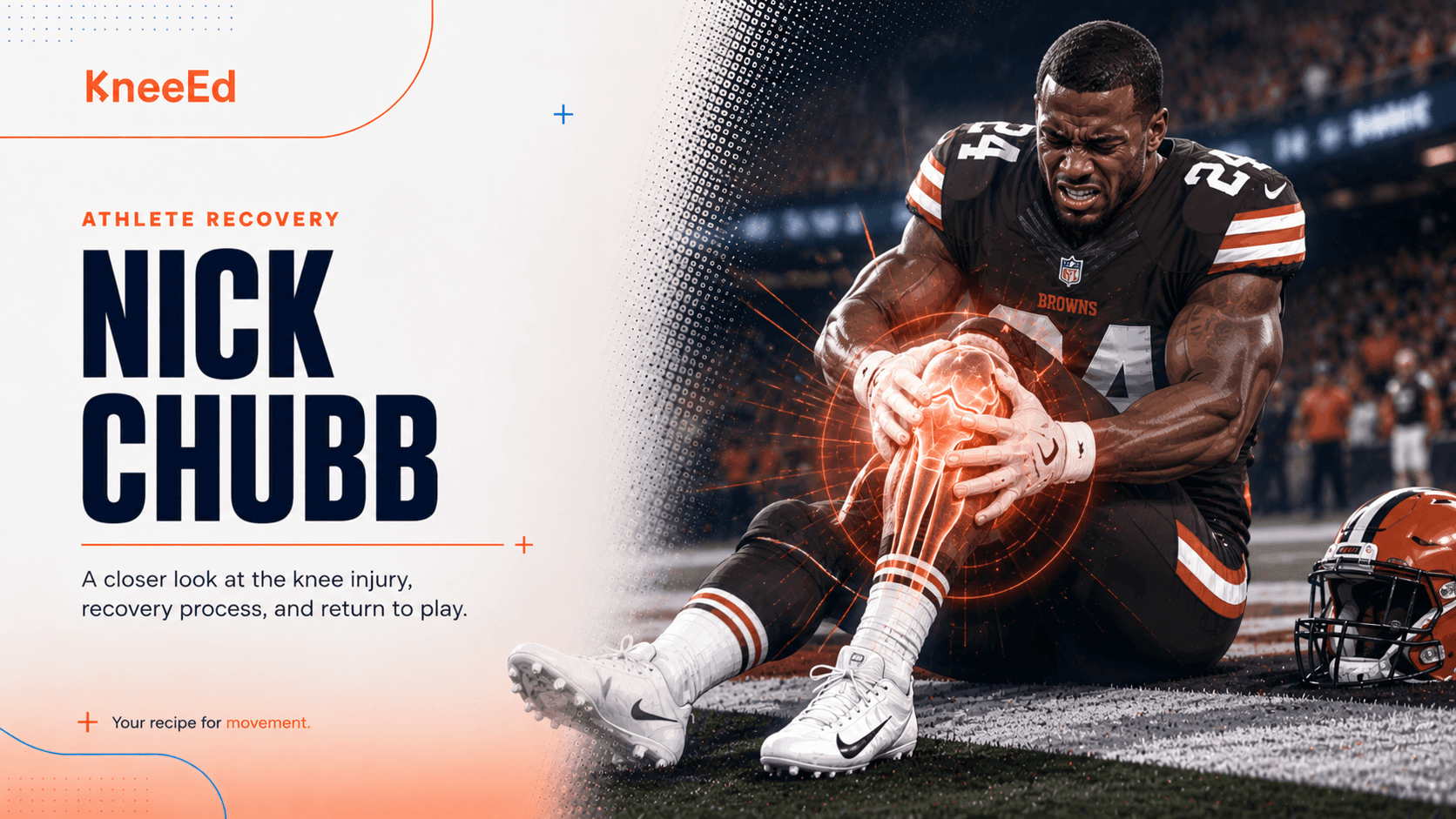
On the second play of the second quarter on a Monday night in Pittsburgh, September 18, 2023, Nick Chubb took a shotgun handoff near the goal line and planted his left leg. Steelers safety Minkah Fitzpatrick came downhill out of the end zone and drove a low hit into the side of it. The leg bent in a direction legs do not bend. ESPN cut its cameras away. Players on both sidelines turned their backs. A stadium that had been roaring went silent in a way football stadiums almost never do.
What almost no one watching knew was that Chubb had been here before. Eight years earlier, on the first play from scrimmage against Tennessee, the same left knee had come apart. He already knew the operating room, the brace, the crutches, the months. This time the fear was not the unknown. It was the known. And this time the injury was worse, because it finally took the one ligament 2015 had left alone.
He would spend two surgeries and thirteen months rebuilding a knee that had now failed catastrophically twice, and the hardest part of it never made a single highlight.
The cascade: what a multi-ligament knee injury actually is
To understand the recovery, you have to understand exactly what was broken, because the diagnosis is what dictated everything that followed. The 2023 injury was not a torn ACL, the single-ligament tear most fans picture when a knee buckles. It was a multi-ligament complex knee injury, the severe end of the entire spectrum, and it tore four structures at once: the medial collateral ligament (MCL), the anterior cruciate ligament (ACL), the medial meniscus, and the medial capsule, the connective sleeve that wraps the joint. In sports medicine, a pattern this broad has a blunt name. It is a knee dislocation pattern, one of the most serious non-fracture injuries a knee can sustain.
The mechanism explains why so much failed at once. Fitzpatrick's hit combined three forces in a single instant: a valgus load that pushed the shinbone inward, a hyperflexion that folded the joint past its safe range, and an internal rotation that twisted the bones against each other under body weight. No single one of those is necessarily catastrophic. Together, applied to a planted leg, they overwhelm the knee's restraints in sequence.
Why one tear becomes four
A multi-ligament injury is not four separate accidents. It is a cascade, where the failure of the first structure transfers load to the next, which fails and transfers load again. On the medial side of the knee, the order goes roughly like this:
- The MCL is the primary restraint against valgus, the inward-buckling force. It is the first to go, taking the brunt of the hit.
- With the MCL torn, the medial meniscus, which doubles as a secondary shock absorber and stabilizer, is left exposed and is torn by the rotation and compression.
- The medial capsule, the next line of secondary support, ruptures as the joint distends past the space it was built to hold.
- The ACL, which normally only assists against valgus and rotation, is now the last structure standing against forces it was never designed to carry alone. It overloads and tears.
Once you see the cascade, the seriousness is obvious. The knee did not lose one stabilizer. It lost the entire medial column and a cruciate ligament in the center of the joint. Where an isolated ACL tear leaves the rest of the architecture intact to support the rebuild, a knee dislocation pattern leaves almost nothing to lean on. That is why these injuries demand surgery, why they take far longer than the nine-to-twelve months people associate with an ACL, and why the risk of post-traumatic arthritis and lasting joint-sense deficits runs so much higher.
The same knee, the second time
There is a detail in Chubb's history that no clinician can ignore. The 2023 injury hit the same left knee he had blown out in October 2015, on the first play of a Georgia-Tennessee game, when he tore the PCL, the MCL, and the LCL, a three-ligament dislocation pattern that spared only the ACL. Put the two injuries side by side and a striking fact emerges: across the two events, every one of the four major ligaments in that single left knee has been torn at some point. The MCL has now gone twice.
Two catastrophic multi-ligament injuries to the same limb, eight years apart, is rare enough that it raises a real question about predisposition. It can point toward underlying factors, ligament laxity, the slope of the shinbone, lingering deficits in the way the joint senses its own position, that make a knee more vulnerable than average. That does not diminish the comeback. It frames it. This was not a healthy knee that got unlucky once. It was a knee that had already been rebuilt, asked to be rebuilt again, more extensively, and the people around it knew exactly what they were dealing with.
Two surgeries: the staged logic of the rebuild
Both 2023 operations were performed by Dr. James Voos, the Cleveland Browns' head team physician and chair of orthopedic surgery at University Hospitals' Drusinsky Sports Medicine Institute. The choice that defined the whole timeline was to do the work in two stages rather than one. Chubb went under twice, six weeks apart, and that sequencing was not hesitation. It was the safer, evidence-based way to rebuild a knee dislocation pattern.
Surgery one: stabilize the medial column
The first operation, on October 3, 2023, addressed the medial capsule, the meniscus, and the MCL, the structures of the medial column that the cascade tore first. Voos used a NanoScope, a pinhole-sized camera that lets a surgeon confirm the diagnosis and work through tiny incisions with minimal trauma to the surrounding tissue. That matters more than it sounds. Less surgical insult to the soft tissue means less inflammation, which means the knee can begin gentle motion sooner, and early motion is one of the strongest predictors of a good outcome.
The meniscus decision in that first surgery is its own quiet lesson. In a young, powerful athlete, a torn medial meniscus is repaired whenever possible rather than removed. The meniscus is the joint's load-spreader and shock absorber; cut it out and you may get a faster recovery, but you concentrate force onto the cartilage and raise the lifetime risk of arthritis. Preserving it, augmented with scaffold material to help the repair take, protects the joint for the long haul at the cost of a longer heal. For a running back who needs that knee to survive a career of collisions, that is the right trade, and it is part of why the timeline ran as long as it did.
Surgery two: reconstruct the ACL, once the inflammation settles
The second operation, on November 14, 2023, reconstructed the ACL. Waiting six weeks to do it was deliberate. Reconstructing the cruciate ligament in the same sitting as the medial repair invites complications, the bone tunnels drilled for different grafts can converge and weaken each other, and operating into a freshly traumatized, swollen joint is riskier than operating into one that has begun to settle. Staging the ACL after the medial side has started to heal is the recognized way to reduce those problems in a multi-ligament knee.
For the graft itself, Voos used a biocomposite material engineered to fit smaller spaces and to incorporate into the body over time rather than persist as a foreign object. That last property is the point: some hardware can, over years, calcify or turn to bone and create its own problems, and a material that the body absorbs and integrates avoids that fate. It is the kind of choice that does not change the highlight on the night a player comes back, but changes how the knee ages over the decade after.
There is also an honest read hidden in the fact that two surgeries were needed at all. With complex multi-ligament injuries, the initial imaging routinely underestimates the damage; the surgeon often finds more once inside the joint. A staged plan absorbs that uncertainty gracefully. It is slower than a single heroic operation, and it is safer, and Voos chose safer.
The medical reality, stated plainly. This sits at the severe, surgical, long end of the knee-injury spectrum.
4
Structures torn in 2023: MCL, ACL, medial meniscus, and medial capsule. A knee dislocation pattern, not an isolated tear.
2
Staged surgeries, six weeks apart. Medial column first (Oct 3), ACL second (Nov 14), the recognized approach for multi-ligament knees.
All 4
Of the four major ligaments in that one left knee, every one was torn across his two injuries. The MCL went twice.
13 mo
From injury to a meaningful return. Long by any standard, and roughly four-plus months longer than an isolated ACL.
The protocol: thirteen months, phase by phase
The rehabilitation that followed was a full-time, professionally staffed operation, and it is worth naming the people, because that staffing is part of why it worked. Inside the Browns facility, assistant athletic trainer Pat Rock oversaw the daily progression. Assistant strength coach Dale Jones led the upper-body and conditioning work. Joe Sheehan, the team's senior vice president of player health, coordinated the overall plan, and head coach Kevin Stefanski checked in daily, watching the work from his office window. Back home in Georgia, the people who had rebuilt his knee the first time were involved again: his longtime strength coach Mike Worthington, who has trained him since the eighth grade, and physical therapists Michael Trammel and Jeff Giddens. The rehab science below is evidence-based consensus for multi-ligament reconstruction; where Chubb's exact session-level routine is not public, the phases reflect published guidelines that his reported progress tracked.
Phase one: protect, and refuse to let the leg switch off (roughly weeks 0 to 6)
The earliest weeks are governed by biology, not ambition. The knee was held in a hinged brace locked near full extension, non-weight-bearing on crutches, while the surgical repairs began to take. The goals were narrow and specific: control the swelling, protect the graft and the medial repair, and start regaining motion before the joint stiffened. A continuous passive motion machine moved the knee gently through a safe arc. Quad-set and straight-leg-raise work began almost immediately, not to build strength yet but to keep the quadriceps from shutting down, which it does fast and stubbornly after knee surgery.
The bracing was staged with intent. Around week two, the brace was unlocked for passive range-of-motion work in a protected zero-to-ninety-degree window, the range that does not stress the healing tissue at deep bend. This is the modern consensus that early, controlled motion produces better outcomes than prolonged immobilization, with fewer lasting range-of-motion deficits down the line.
Phase two: load the leg, and protect the mind (roughly weeks 6 to 16)
Weight came back gradually. The medical standard is a progression to roughly fifty percent weight-bearing by about six weeks, then on toward full weight-bearing as the tissue tolerates it. One nuance specific to a knee with this history: hamstring exercises are typically restricted in the early window when the posterior structures need protection, a detail that quietly shapes which lifts are safe and when.
While the knee was still on a leash, Dale Jones kept the rest of the engine running. Seated machines in an auxiliary weight room let Chubb maintain upper-body strength and conditioning without loading the joint. Jones was explicit that this work was not only physical. Being able to train hard at something, anything, was a psychological lifeline during the months when the knee itself could do almost nothing. That is not a soft observation. Maintaining an athlete's identity as someone who works is part of how the rehab holds together.
Heatnopointdidn'tthinkhewasgoingtomakeit.Whenyourehabanathletelikethat,like,sky'sthelimit.
Phase three: build real strength (roughly months 4 to 9)
Once full weight-bearing was secure, the work turned to rebuilding force. Squats were loaded progressively, and the numbers are genuinely striking: by July 2024, roughly eight months after the injury, Chubb was documented squatting over 540 pounds. The program layered in Olympic-style movements, hang cleans and snatch high pulls, the kind of explosive lifting that asks a knee to absorb and produce force the way the sport will. Daily sessions ran from eight to nine in the morning, stacking strength, rehab, and conditioning.
What made the strength phase work was not the ceiling but the daily calibration. Pat Rock kept the communication constant and the plan flexible, adjusting the load based on how the knee felt that morning, on Chubb's own report of soreness. That is the difference between a written program and a real rehabilitation: a written program follows the calendar, a real one listens to the joint and modifies. A 540-pound squat is a headline, but the discipline of backing off on a sore day is what got him there intact.
Phase four and five: relearn to run, then relearn the sport (roughly months 8 to 13)
Independent running returned around April 2024, and the on-field progression that followed was deliberately graded. It began with short thirty-yard runs, brace on, the staff watching how the knee bent and loaded. Speed was added in increments over weeks, with video tracking the biomechanics so improvements could be seen rather than guessed. Only after the running base was solid did the football-specific work begin: change-of-direction drills at reduced speed climbing toward full speed, individual skill work, and eventually play-call drills where Rock and Jones called the plays and Chubb executed them, simulating the cognitive and physical chaos of a real snap.
This is the part of the protocol that separates a knee that has healed from a knee that is ready. Straight-line running is the easy test. Cutting, decelerating on a planted foot, reacting to a defender, those are the moments that tore the knee in the first place, and they are trained last, on purpose, only after the strength and the running mechanics are in place to survive them.
Sep 18, 2023 · Pittsburgh
The knee gives way, the second time.
A low hit on a goal-line carry combines valgus, hyperflexion, and rotation. MCL, ACL, medial meniscus, and medial capsule all fail. Season over on the field.
Oct 3, 2023 · Surgery one
The medial column, repaired.
Dr. James Voos addresses the capsule, meniscus, and MCL via NanoScope, working through pinhole incisions to minimize tissue trauma and preserve the meniscus.
Nov 14, 2023 · Surgery two
The ACL, reconstructed.
Six weeks later, with the medial side settling, Voos reconstructs the ACL using a biocomposite graft designed to incorporate into the body rather than persist as foreign hardware.
Apr - Jul 2024 · Strength and running
540 pounds, and the first runs.
Independent running returns around April. By July, eight months post-injury, a documented squat over 540 pounds, alongside hang cleans and snatch high pulls.
Oct 20, 2024 · Return
Back on the field after 398 days.
Cleared on October 2, he debuts in Week 7 against Cincinnati and scores a rushing touchdown, his first since the injury, 398 days later.
Nov 21, 2024 · Pittsburgh, again
Two touchdowns where it happened.
Back at the stadium where the knee was destroyed, in heavy snow, he scores twice, including the game-winner with 57 seconds left. Browns win 24-19.
The part nobody filmed
Chubb is not a loud man. He has spent a career letting his running do the talking and showing almost no interest in a camera. So it surprised people when, days before his 2024 return, he published a personal essay in The Players' Tribune. It was the first time most fans heard what the previous year had actually held, and the most useful thing in his entire story is that he said it at all.
He wrote about the dark thoughts that arrived right after the injury, the ones the comeback narratives leave out. For an athlete whose body had already been rebuilt once, the second injury landed somewhere deeper than the knee.
Theymightnotbeabletoputmebacktogetheragainthistime.Thismightbeawrap.
That fear was not irrational, which is exactly why it matters. A surgeon cannot guarantee full function after a four-structure knee injury. The honest medical truth is that even a technically successful multi-ligament reconstruction does not promise a return to who you were, and Chubb, who had already done this once, knew that better than the people telling him he would be fine. The line that landed hardest was the simplest one.
PeopleonlyseemeonSundays,andtheydon'tknowwhatit'sbeenlikethispastyear.It'sbeenalotofdowns.Lotofhardwork.Lotofstress.
What carried him through was not slogans. It was scaffolding. The daily contact with Rock, the constant adjustment, Stefanski's check-ins, Jones giving him something to push against when the knee could not, these were the structure that held a person up across thirteen months. And underneath it was something older: a mantra his grandmother, Brenda Weaver, taught him as a child and that he came back to during the recovery, a few plain words repeated to himself in the mirror. The research on serious-injury rehab keeps arriving at the same place athletes already know. Psychological readiness is not a side effect of the physical recovery. It is part of it, and self-belief is one of the mechanisms that supports relearning how to move.
I'msmart,I'mintelligent,andIbelieveinmyself.
Honest expectations: what came back, and what did not
It would be easy to take the wrong lesson from a comeback like this, so it is worth being precise about what actually happened, because the comeback narrative tends to round up.
The thirteen-month timeline is an outlier, not a target
Chubb returned to game action 398 days after surgery, with his meaningful return, the two touchdowns in Pittsburgh, coming about thirteen months out. For a four-structure knee injury, that is genuinely exceptional, and it was made possible by advantages most people recovering this injury will never have:
- He was 28, younger than the average career NFL running back, with strong healing capacity.
- He had an elite surgical team and access to NanoScope technology and biocomposite grafts that are not standard care.
- He had a full-time professional rehab staff, daily, for over a year, plus a second support team back home in Georgia.
- He had the financial resources for an extended, individualized recovery with no pressure to return to ordinary work in the meantime.
- He had deep psychological resilience and a support structure built around him every day.
For a non-elite athlete, a multi-ligament knee injury more typically takes eighteen to twenty-four months to return to a pre-injury level of sport, if it returns there at all. Even after a surgery called successful, a meaningful share of people, on the order of twenty to thirty percent in the literature, live with persistent instability or swelling. Long-term brace dependence is common with a multi-ligament history. And the arthritis risk is materially elevated, with studies reporting rates several times higher than after an isolated single-ligament injury. The 398 days is a window into how thorough the process can be. It is not a clock for anyone else to race.
Back together is not the same as restored
The harder honesty is about production. Chubb came back, and his on-field numbers tell a careful story. Across eight games in the 2024 season, he ran for 332 yards and three touchdowns on 102 carries, about 3.3 yards per carry, well below his career average of 5.2. With the Houston Texans in 2025 he improved to 506 yards on 122 carries, roughly 4.1 yards per carry, with an average of about 2.7 yards after contact. Better, still short of the back he had been, and notably he lost the starting role over the season.
Read those numbers fairly and they describe something real. Structurally, the tissues healed. Functionally, he is running, cutting, and scoring at roughly three-quarters of his pre-injury production baseline. Psychologically, he returned and played, which after a four-structure injury and the dark months that preceded it is its own achievement. But back together and fully restored are not the same sentence, and a knee rebuilt across two surgeries and four structures is a knee to be managed for the rest of a career, not a knee that has been reset to factory.
What protects a twice-injured knee going forward
Two major injuries to the same limb keeps the recurrence question open. The re-injury risk on a knee with a multi-ligament history runs meaningfully higher than average, which makes the ongoing, unglamorous work the actual job. The strength rebuild that produced a 540-pound squat is necessary, but strength alone does not restore the joint's sense of its own position, and proprioceptive deficits can persist even when the numbers in the weight room look elite. The pieces most worth sustaining after a knee like this are:
- Proprioceptive and balance training, single-leg work that rebuilds the joint sense strength training does not address.
- Deceleration and eccentric strength, the braking capacity that protects a knee in exactly the planted-foot moments that tore it, often underweighted next to concentric lifting.
- Lateral and change-of-direction stability work, the side-to-side control that straight-ahead running never trains.
- Brace use during sport, which has evidence behind it for reducing re-injury in athletes with a multi-ligament history.
What the quiet comeback teaches
There is a version of this story that ends with two touchdowns in the snow in Pittsburgh, on the exact ground where the knee was destroyed fourteen months earlier. That moment was real, and it was earned. But it was just the part that got filmed. The comeback was the thirteen months before it that did not: the two surgeries staged for safety, the brace unlocked one degree at a time, the upper-body work that kept a man feeling like an athlete while his knee could do nothing, the daily calibration that backed off on a sore morning so it could push on a good one.
What translates from a story like this is smaller and quieter than the highlight, and it sounds like him. He treated the knee as a problem his team would solve over months, not a verdict delivered on the field. He let other people carry him through the stretch where he could not carry himself. He said the hard part out loud, against his own quiet nature, which is the most useful thing he did. And he did the work when no one was watching. For a knee taken apart twice, across four structures, that is not a slogan. It is the only way it works.
References
- 01Cleveland Browns · Against all odds: the story of Nick Chubb's comeback · Accessed June 2026
- 02ESPN · Nick Chubb's comeback from a devastating knee injury · Accessed June 2026
- 03WKYC · Rebuilding Nick Chubb's knee: exclusive insight into the Browns' surgery and recovery · Accessed June 2026
- 04BrownsZone · Nick Chubb shares recovery story in letter to fans · Accessed June 2026
- 05NBC Sports / ProFootballTalk · Nick Chubb had MCL, meniscus surgery; will have surgery on his ACL · Accessed June 2026
- 06ESPN · Nick Chubb has 2nd knee surgery; Browns expect RB back in 2024 · Accessed June 2026
- 07BrownsZone · Nick Chubb scores 2 TDs, including winner, in first meeting with Steelers since injury · Accessed June 2026
- 08Yahoo Sports · Nick Chubb returning 13 months after knee injury · Accessed June 2026
- 09ESPN · Georgia Bulldogs lose star RB Nick Chubb to left knee injury · Accessed June 2026
- 10NCBI / PMC · Rehabilitation after multiligament knee reconstruction: principles and evidence · Accessed June 2026
- 11Behind the Steel Curtain · Nick Chubb injury on Minkah Fitzpatrick hit: Browns vs. Steelers Week 2 · Accessed June 2026
- 12Pro Football Focus · Nick Chubb player profile and advanced rushing metrics · Accessed June 2026