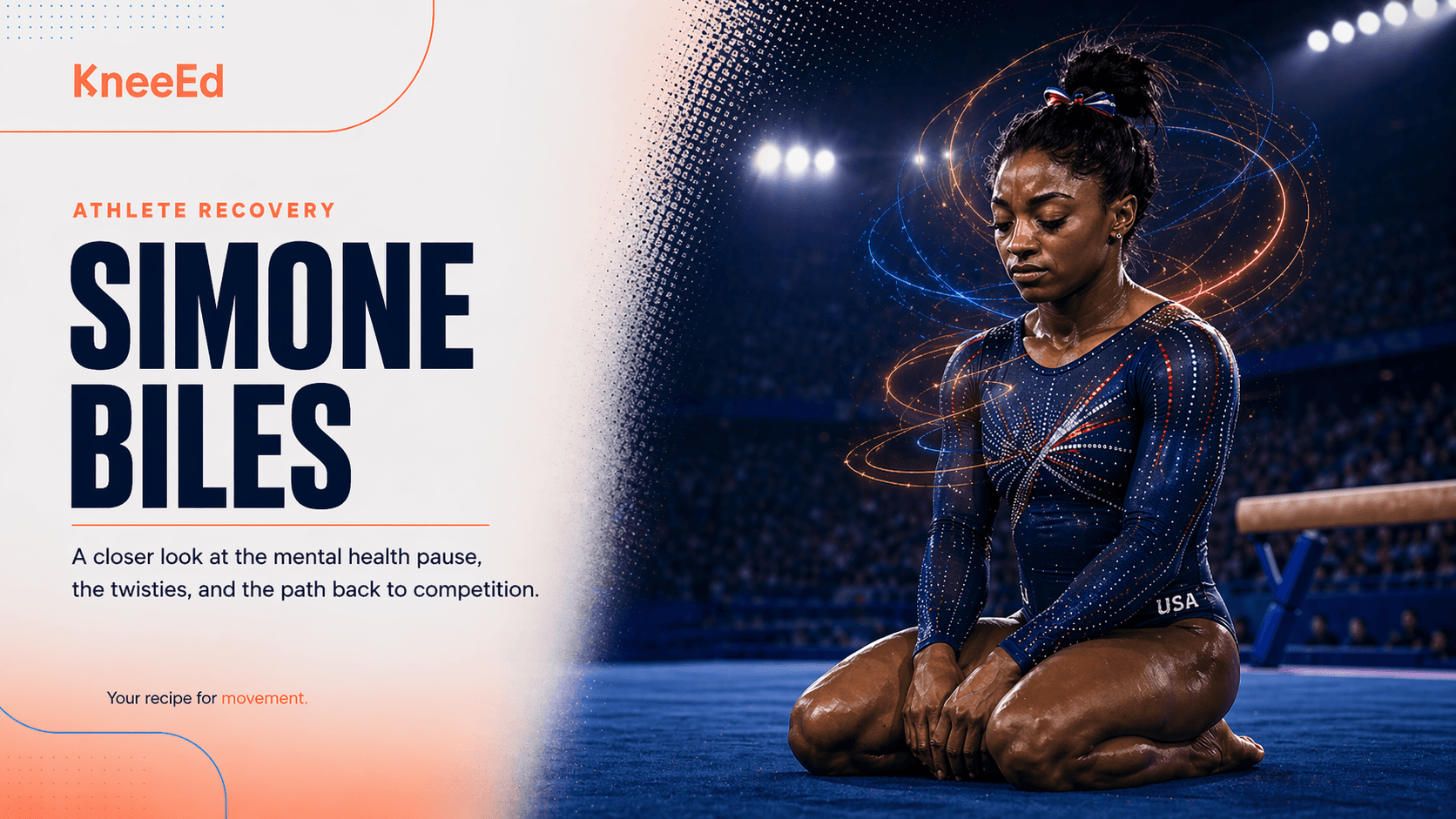
On July 28, 2021, during a vault warm-up at the Tokyo Olympics, Simone Biles left the table for a Yurchenko double pike, a skill she had landed thousands of times, and her brain lost track of where her body was. She came down on her back instead of her feet. Moments later she withdrew from the team final, and then from all four individual finals: all-around, vault, beam, and floor. She had not torn a ligament. She had not failed a test. What had failed was something most people never have to think about, the brain's real-time sense of itself in space.
Literallycannottellupfromdown.It'sthecraziestfeelingever.Nothavinganinchofcontroloveryourbody.What'sevenscarierissinceIhavenoideawhereIamintheairIalsohaveNOideahowI'mgoingtoland,orwhatI'mgoingtolandon.
Gymnasts call it the twisties. The name is almost too small for what it is. It is not nerves and it is not a confidence dip you can will your way through. It is a genuine breakdown in the brain's motor control, the same circuitry that lets you touch your nose with your eyes closed, scaled up to a body rotating at speed several feet off the ground. The recovery that followed had no clean clinical label and no schedule. It ran about 22 months, and it changed how elite sport talks about the line between mental and physical health.
From the Tokyo withdrawal to the Paris podium, the long way back, in numbers.
22 mo
From the July 2021 Tokyo withdrawal to the August 2023 return to competition at the U.S. Classic.
1/wk
Individual therapy sessions held throughout recovery, a commitment she has called religious.
3 gold
Golds at Paris 2024 (team, all-around, vault), plus a silver on floor.
11
Career Olympic medals after Paris, matching Vera Caslavska's all-time record.
The recovery that nobody could schedule
Start with what the recovery actually was, because the popular version gets it backward. The story is usually told as if Biles took some time off, got her head right, and came back. That is not what happened. What happened was a long, structured, professionally supported program of rebuilding two systems at once, the psychological and the physical, because in her case they were never two separate things. The work was led by her coaches, the married coaching team Cecile and Laurent Landi, who had guided her since 2017, and it was anchored by weekly therapy that did not pause when the cameras left.
She did not rush a return to the apparatus. For most of 2022 she stepped back from intensive training entirely. A graduated return began around September 2022, roughly fourteen months of minimal training before she was even building toward real volume. Two-a-day sessions resumed in January 2023. Only after her April 2023 wedding did she commit to full-force preparation. The August 2023 competition return came at the end of a deliberate, phased ramp, not at the front of a comeback narrative.
The phases, in order
The sequence matters more than any single piece of it. Recovery from a complex trauma layered on top of a motor-control failure does not respond to intensity. It responds to order, and to time.
- Stop and stabilize. The first move was to remove the demand entirely. Through most of 2022 there was no push to reload the hardest skills. The body and the brain came out of acute crisis before anything else was asked of them.
- Treat the root, weekly and without exception. Individual therapy ran throughout, described as a non-negotiable weekly appointment. The modalities documented include trauma-focused cognitive therapy, EMDR (Eye Movement Desensitization and Reprocessing), and mindfulness practice, aimed at the underlying trauma, not just the symptom of the missed skill.
- Re-educate the body's sense of itself. Alongside the talk-based work came proprioceptive re-education: balance work, mindful movement, and mental imagery, rehearsing skills in safe contexts so the brain could rebuild a trustworthy internal model before any real risk was added.
- Graded skill exposure. Skills came back in deliberate order of difficulty, lower-risk first, with the air-sense rebuilt before the rotations got fast. Graded exposure is the spine of the physical return, the opposite of forcing the hardest vault to prove the fear is gone.
- Ramp the volume, late. Two-a-days in January 2023, full-strength preparation only after April. The conditioning load was added last, once the foundation was stable, not first to manufacture readiness.
IamdoingtherapyweeklytokeepeverythingintunesothatIfeelcomfortableandconfidentenoughtobecompeting.
Read that quote closely, because it carries the whole posture. Therapy is not framed as a thing she did once to fix a broken season. It is described as ongoing maintenance, the work that keeps the system in tune so that competing is even possible. The Paris medals did not come from the therapy ending. They came from the therapy continuing.
What the twisties actually are, in the brain
To understand why this took the better part of two years, you have to understand what broke. The body has a sense most people are never forced to think about, called proprioception, the brain's continuous, real-time map of where every limb is in space. It is built from a flood of signals: mechanoreceptors in the muscles, tendons, and joints reporting position and tension at roughly 200 times a second, the vestibular system in the inner ear reporting balance and head rotation, and vision reporting the world rushing past. For a gymnast in the air, those three streams are the only thing standing between a rotation and a broken neck.
The internal model, and the mismatch
The brain does not just receive those signals. It predicts them. The cerebellum holds an internal model, a learned forecast of exactly what a movement should feel like, built from years of repetition. When you perform a skill you have drilled ten thousand times, the cerebellum runs ahead of your body, predicting the sensory feedback a fraction of a second before it arrives, and the movement runs on autopilot. This is what lets an elite gymnast twist and somersault faster than conscious thought could ever steer.
The twisties are what happens when that prediction and the incoming feedback stop matching. Under acute stress, a spike in the hormone cortisol impairs the very brain regions responsible for smooth motor learning and execution. The automatic sequence stutters. In the gap, the athlete unconsciously falls back to conscious motor control, slower, jerkier, more error-prone, the way a pianist falls apart the moment they start thinking about each finger. The cerebellum detects the mismatch between what it predicted and what is actually happening, flags an error it cannot resolve, and triggers a protective disorientation. That disorientation is the twisties. It is not the system failing at random. It is the system refusing to keep running a dangerous program it no longer trusts.
This is the counterintuitive heart of it: the twisties are not a malfunction. They are a safety mechanism. The brain is pulling an emergency brake on a maneuver it has decided it cannot guarantee, because the alternative is a catastrophic landing.
Why the body and the feelings share the same wiring
Here is the part that explains why Biles needed therapy and balance work in the same recovery, not one or the other. The proprioceptive system and the brain's emotional regulation system are not separate departments. They share neural highways. Vagal nerve pathways connect the inner ear and the body's position sensors to the brain's emotional centers, the amygdala and the insula. The same circuitry that tells you where your body is also feeds the circuitry that tells you whether you are safe.
That shared wiring runs in both directions, which is the whole point. It is why anticipatory anxiety, the dread before the vault, floods the motor system with the exact cortisol that degrades the skill, a vicious loop in which the fear of the twisties helps produce the twisties. And it is why the treatments that work for trauma, deep breathing, meditation, somatic and body-based therapies, reach the motor system at all. They are not a soft add-on to the real physical work. They are operating on the same hardware.
How you rebuild a dropped sense
Once you see the twisties as a protective shutdown rooted in a trust failure across that shared wiring, the recovery toolkit makes sense. None of it is a hack. Each piece targets a specific part of the broken loop.
- EMDR and cognitive processing work to defuse the underlying trauma and reframe the catastrophic thinking, lowering the baseline stress load that triggers the cortisol spike in the first place.
- Mental imagery and simulation, rehearsing the skill vividly in a safe context, so the cerebellum can rebuild its internal model without the body actually being at risk while the prediction is still unreliable.
- Graded skill exposure, reintroducing rotations from low difficulty upward, so the brain accumulates evidence that the prediction matches reality again before the speed and height climb.
- Proprioceptive re-education, balance exercises, beam work, vestibular training, and mindfulness, retraining the position-sense and balance streams directly.
- Pre-competition routines and attentional-focus training, keeping the skill on the automatic track and out of the conscious, jerky, error-prone mode that the stress response forces it into.
Biles' recovery used precisely this kind of integrated approach, and its length, roughly 22 months, sits squarely inside what the literature describes for a motor-control breakdown compounded by complex trauma. Recovery timelines in this space typically run from six months to two years. Hers was at the long end, which is what the combination of factors would predict. The duration was not weakness or indulgence. It was the timeline the underlying biology actually required.
Why a missed vault is a life-and-death problem
It is tempting to file the twisties under performance anxiety, an unfortunate but ultimately cosmetic problem. The Tokyo vault is the reason that framing is wrong. Biles was performing a Yurchenko double pike, one and a half forward somersaults stacked with two twists, and she lost her air sense in the middle of it. She came down on her back. At the speeds elite vaulting generates, north of twenty miles per hour at the point of contact, landing on your back or neck instead of your feet is not an embarrassment. It is a concussion, a spinal fracture, or a paralysis risk. The brain's emergency brake exists precisely because the cost of a misjudged landing is measured in vertebrae.
Why it compounds instead of fading
What makes the twisties genuinely dangerous rather than merely scary is that, left alone, the problem feeds itself. Four forces stack. The first is the immediate physical risk on every attempt. The second is the psychological loop already described, where anticipatory anxiety raises cortisol, which raises the chance of recurrence, which raises the anxiety. The third is that for an elite athlete the condition is career-threatening, which loads still more stress onto the system. And the fourth, in Biles' specific case, was a deep well of pre-existing trauma.
That last factor cannot be skipped past. Biles was one of more than 150 gymnasts sexually abused by the former Team USA physician Larry Nassar, and she carried that, plus two-plus years of relentless media coverage of it, into Tokyo. The unresolved trauma was not background noise to the 2021 crisis. Clinicians and Biles herself have identified it as a contributing cause. A nervous system already running hot on hypervigilance has less margin before the protective shutdown fires.
IfyoulookedateverythingI'vegonethroughforthepastsevenyears,IshouldhavenevermadeanotherOlympicteam.IshouldhavequitwaybeforeTokyo,whenLarryNassarwasinthemediafortwoyears.Itwastoomuch.
She finished that thought by saying she refused to let Nassar take something she had worked for since she was six. Hold both halves together, because that is the honest picture. The decision to keep going was an act of will against an abuser. And the system underneath was carrying more than it could safely hold. Will did not override the biology. The biology eventually spoke, on the largest stage there is, and the protective response did its job.
What actually reduces the risk of it coming back
Because the twisties are a stress-triggered shutdown rather than a discrete injury, the things that lower the odds of recurrence are not exotic. They are the unglamorous fundamentals of a regulated nervous system, maintained continuously rather than crammed before a meet.
- Off-season mental-health maintenance treated as training, not triage: ongoing weekly therapy, deliberate meditation, and the protected sleep that motor learning and emotional regulation both depend on.
- Skill progression that avoids chronic sleep debt and overtraining during the periods when new skills are being acquired, since fatigue is itself a cortisol source.
- Addressing the root causes directly, burnout, unresolved trauma, and outside pressure, rather than only drilling the missed skill.
- Proprioceptive resilience work kept in the routine: balance and beam practice, vestibular training, and mental imagery rehearsed in safe contexts, so the internal model stays well-maintained.
Note what is absent from that list. There is no mental-toughness trick, no way to grit the air sense back into place. Willpower applied to a dissociated, hypervigilant nervous system does not restore the motor program. It deepens the dissociation. The recovery is the slow rebuild, or it is nothing.
July 28, 2021 · Tokyo
Air sense gone mid-vault. Withdrew from the team final.
Came down on her back off a Yurchenko double pike, then withdrew. Posted that her mind and body were simply not in sync.
July to August 2021 · Tokyo
Withdrew from all four individual finals.
All-around, vault, beam, and floor. The withdrawal redrew the line elite sport draws around mental health.
2022 · Off the apparatus
Most of the year stepped back. Weekly therapy begins as a fixture.
Trauma-focused work, EMDR, mindfulness. A graduated return to training around September, roughly fourteen months of minimal load.
January to April 2023 · Rebuild
Two-a-days resume; full-force prep after the April wedding.
Volume added last, on top of a stabilized foundation. Graded skill exposure rebuilds the air sense before the rotations get fast.
August 5, 2023 · U.S. Classic
First competition in roughly two years. Won the all-around.
59.100 in the all-around, about five points clear, plus beam, floor, and the day's top vault, a 15.400 Yurchenko double pike, the very skill that broke in Tokyo.
October 2023 · Antwerp Worlds
Four world golds and a vault silver in her return to the world stage.
Team gold, a sixth all-around world title, a fourth beam title, and a sixth floor title.
July to August 2024 · Paris
Three Olympic golds and a silver. Eleven Olympic medals in all.
Team, all-around (59.131), and vault gold, silver on floor, and a fall on beam (13.100, fifth). Still elite, still human.
What the comeback honestly proves, and what it does not
Biles came back and won, spectacularly, and it is worth being clear-eyed about exactly what that does and does not demonstrate. The 2023 U.S. Classic was her first competition in roughly two years, and she won the all-around by about five points, took beam and floor, and posted the day's highest vault, a 15.400 Yurchenko double pike, the same family of skill that had failed in Tokyo. At the Antwerp World Championships that October she won four golds and a vault silver. At Paris 2024 she won team, all-around, and vault gold and a floor silver, reaching eleven career Olympic medals and matching Vera Caslavska's record. By any measure, a triumph.
Success after trauma looks different than before it
And in the Paris all-around, on beam, she fell. She scored 13.100 and finished fifth on the apparatus. That detail matters, not to diminish the comeback but to tell the truth about it. The athlete who returned was the most decorated gymnast alive and also a person carrying complex trauma in an ongoing way. Both are real at once. The honest frame is not pre-trauma Simone, restored. It is a different, still extraordinary athlete who built a life and a career that no longer depend on being untouched by what happened to her. Success after trauma is not the same shape as success before it, and pretending otherwise sets a trap for everyone watching.
Recovery runs on the body's timeline, not the calendar's
The single most copyable lesson in this story is about pace, and it cuts against everything competition culture rewards. Biles' recovery did not sync to an Olympic cycle or a meet schedule. It needed roughly 22 months before she could step into a competition gym, and it included regression along the way: a partial return in late 2022, dips through the 2022 holidays, a re-commitment in January 2023, a long ramp from spring into summer. None of that was failure. Regression is a normal, expected phase of recovery from a nervous-system injury. A plan that does not budget for the dips is a plan that breaks on the first one.
And the therapy did not end when the medals started. Weekly sessions appear to be a permanent fixture, ongoing maintenance for complex trauma rather than a one-time fix that the Paris results retired. That is not a sign that the recovery is incomplete. It is what realistic self-care for a chronic condition looks like. The maintenance is the recovery, indefinitely.
IkindafeltlikeIwasinjailwithmyownbrainandbody,justlike,Ijustfeelsoashamed.
Physical health is mental health, and the reverse
If there is one idea to carry out of all the neuroscience, it is that the two halves of this story were never separable. A gymnast cannot perform an elite skill while dissociated, hypervigilant, or running on no sleep, because the same nervous system runs the rotation and the regulation. Sleep, nutrition, stress management, and therapy are not the soft accompaniment to the real training. On the shared wiring of proprioception and emotion, they are the training. Biles did not get her head right and then retrain her body. She retrained one integrated system, and the medals were downstream of doing that honestly and slowly.
Nomedal,noaccoladeorexamresultsaremoreimportantthanyourmentalhealth.
The record book will remember eleven Olympic medals and a return that bordered on the impossible. The more useful thing to remember is the shape of how it happened. A real failure of the brain's motor control, treated as the real and physical thing it is. A root cause, the trauma, addressed weekly and without exception. A body's sense of itself rebuilt from the ground up, slowly, with the hardest skills last. And a timeline that answered to the nervous system rather than the calendar. That is the part anyone can carry, at any scale: trust the read, not the date.
References
- 01TIME · What Are the Twisties? The Gymnastics Phenomenon, Its Causes and Treatments · Accessed June 2026
- 02Stanford Neuroscience · What's happening inside Simone Biles' brain when the twisties set in · Accessed June 2026
- 03Live Science · Simone Biles and 'the twisties': what is it and why is it dangerous? · Accessed June 2026
- 04The Conversation · The twisties, the yips and target panic: why sportspeople sometimes suddenly lose the ability to perform · Accessed June 2026
- 05ESPN · Simone Biles plagued by 'twisties,' says mind and body 'not in sync' · Accessed June 2026
- 06NPR · Simone Biles dominates the U.S. Classic in return to gymnastics after 2-year break · Accessed June 2026
- 07NBC News · Simone Biles returns to World Championships with a new vault and a new mindset · Accessed June 2026
- 08WHYY · Simone Biles' golds at the Antwerp World Championships and her record title haul · Accessed June 2026
- 09CBS News · Simone Biles and the records she set at the Paris 2024 Olympics · Accessed June 2026
- 10CNBC · Simone Biles credits therapy for her success at the Paris Olympics · Accessed June 2026
- 11NPR · Simone Biles, the Olympics and the long road of mental health · Accessed June 2026
- 12Olympics.com · Simone Biles: No medal is more important than mental health · Accessed June 2026
- 13CNN · Simone Biles: Rising and the story of the comeback · Accessed June 2026
- 14988 Suicide and Crisis Lifeline · 988 Suicide and Crisis Lifeline, 24/7 free and confidential support · Accessed June 2026
- 15SAMHSA · National Behavioral Health Crisis Care resources · Accessed June 2026