
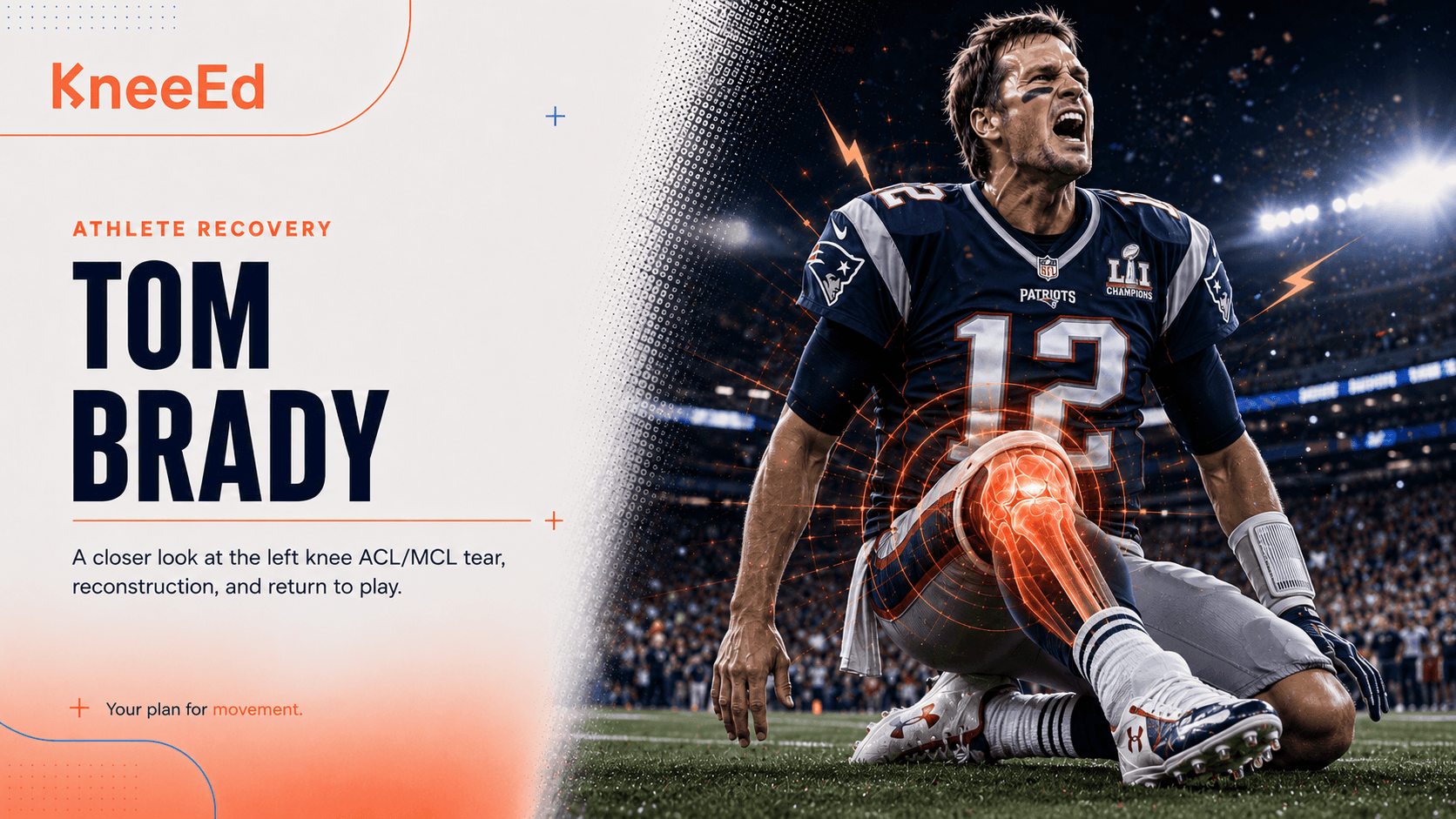
On September 7, 2008, in the first quarter of the first game of the season, Tom Brady dropped back to throw and never saw the hit coming. Kansas City safety Bernard Pollard came free and dove low at Brady's planted left leg while he was still in his passing stance, with almost no chance to brace or absorb the blow. The knee folded. Brady went down, got up, went down again, and was helped off the field. The diagnosis was the one that rearranges a career: a torn anterior cruciate ligament and a torn medial collateral ligament in the same knee. He would not play another snap that season.
He was thirty-one, a three-time Super Bowl champion at the height of his powers, and he had just lost the thing every quarterback is supposed to be able to count on, a stable base to throw from. The reconstruction, performed by Dr. Neal ElAttrache, went as planned. Then it did not. A staphylococcus infection took hold in the operated knee within days, the kind of complication that turns a routine elite recovery into a fight to save the joint, and it required multiple additional surgeries to clean out.
He came back the next season and threw for 4,398 yards and 28 touchdowns, won Comeback Player of the Year, and then did not miss another game to injury for fourteen straight seasons, playing elite football all the way to age forty-five.
That second sentence is the real story, and it is not luck. After the injury, Brady built one of the most documented body-maintenance systems in professional sport, the TB12 method, and credited it for a longevity that has almost no precedent at his position. This piece leads with that method, because the founder is right that it is the more useful half. Then it teaches the knee science the injury demanded, and it stays honest throughout about which parts of the method are proven, which are proprietary, and which actually transfer to someone who is not Tom Brady.
The method: five pillars Brady ran every day
The first thing to understand about the TB12 method is that it is not a workout. It is a daily operating system for a body, built with his longtime body coach Alex Guerrero and formalized into a book, an app, a podcast, and a company in 2013. Brady has detailed it more openly than almost any athlete details anything, which is exactly why it is worth studying carefully rather than mythologizing. Strip away the branding and the products, and the system rests on five pillars he ran, in some form, every single day.
Pillar one: pliability, the part he built everything around
Pliability is the idea at the center of the whole system, and it is the one that needs the most careful handling, because it is half real science and half Brady's own framework. His own definition is simple: pliability is the state in which your muscles are long, soft, and resilient. In practice it means targeted, deep-force soft-tissue work, done with foam rollers, vibrating spheres, and band-assisted movement, applied to a working muscle before and after training. The documented dosing is specific: roughly 60 to 90 seconds per muscle group before training, and 90 to 120 seconds after, across the quads, hamstrings, calves, hip flexors, the IT band, and the glutes.
The claim Brady makes for it is that long, soft, pliable muscle absorbs and disperses force better than short, dense, overloaded muscle, and so it is less likely to be injured and faster to recover. Past age forty, he said he spent roughly half of his total training time on pliability, a ratio almost no other athlete approaches. Whether pliability as he frames it is truly superior to strength-focused training is a separate and contested question, addressed honestly later. What is not in dispute is that soft-tissue work measurably, if temporarily, improves tissue compliance and blood flow. The mechanism underneath the brand name is real.
Musclepliabilityisthestateinwhichyourmusclesarelong,soft,andresilient.
Pillar two: resistance bands instead of heavy iron
Brady famously trained with resistance bands far more than with heavy barbells. The TB12 band library is a full strength program in its own right: standing rows, banded pushups, core rotations, deadlifts, biceps curls, triceps extensions, deceleration lunges, shoulder presses, and X-band squats. The reps run high, typically 17 to 25 per set, performed at deliberately high speed to near fatigue. The logic is that bands build functional, multi-planar strength while sparing the joints the peak compressive loads that heavy fixed weights deliver, and that the accommodating resistance of a band, which gets harder as it stretches, matches the way muscle actually produces force through a range.
This pillar holds up better than its reputation suggests. Resistance bands genuinely reduce peak joint loading while still building strength through multi-planar movement, and that combination is biomechanically well suited to injury prevention and to a healing or aging joint. It is not magic, and it does not mean barbells are bad. But for a quarterback protecting a reconstructed knee across two decades, choosing accommodating resistance over maximal spinal and knee loading is a defensible, evidence-friendly decision, not a gimmick.
Pillars three, four, and five: water, food, and sleep
The last three pillars are the unglamorous ones, and they are the ones that transfer most cleanly to anyone. Brady hydrated aggressively, targeting roughly half his body weight in ounces of water per day, which at his playing weight worked out to about 112 ounces, plus around 20 ounces of electrolyte-enhanced water on waking. He ate an 80/20 anti-inflammatory diet built on vegetables, whole grains, and legumes, with lean fish and chicken as the smaller share, and he eliminated dairy, nightshades, white sugar, and processed food. And he slept about nine hours a night, lights out between 8:30 and 9:00 PM and awake by 5:00 to 5:30, in a dark, cool, technology-free bedroom, layered on top of a daily set of brain-training exercises.
The method as a daily dose, stated plainly. These are the documented numbers Brady ran, not a prescription, and several pillars are far more universally proven than others.
50%
Share of his training time spent on pliability past age forty, by his own account. Almost no other athlete approaches that ratio.
17-25
Reps per set in his resistance-band work, run fast and to near fatigue, replacing most heavy-barbell training.
112 oz
Approximate daily water target at his playing weight, roughly half his body weight in ounces, plus electrolytes on waking.
9 hr
Nightly sleep, lights out by 8:30 to 9 PM in a dark, cool, tech-free room. The single most evidence-backed pillar.
Of those three, sleep is the most ironclad and the most underrated. Seven to ten hours of sleep drives growth-hormone release, muscle protein synthesis, immune function, and the consolidation of motor learning, all of which a recovering or aging athlete depends on. The hydration target is a real athlete essential, supporting cellular function and neuromuscular signaling. The diet is genuinely anti-inflammatory in its overall shape, even if, as the honest section explains, several of its specific exclusions are not supported by evidence. Brady stacked these because compounding small daily inputs is the whole point. The method is less a secret than a refusal to skip the basics for two decades straight.
The injury: an ACL and MCL tear, then the infection
To understand why Brady built the method he built, you have to understand what failed in 2008 and how close it came to ending things. The hit from Pollard was a contact injury in its purest form. Brady was set in his passing stance, weight on the planted left leg, with no chance to control the eccentric load or yield to the force, when the blow drove into the leg. The knee was loaded inward and bent in a way the ligaments could not survive. The anterior cruciate ligament, which keeps the shinbone from sliding forward and twisting under the thigh, tore. So did the medial collateral ligament, which provides the knee's stability against forces pushing it inward.
A combined ACL and MCL tear is a meaningfully harder problem than an isolated ACL tear, and it is honest to say so. Two stabilizers are gone instead of one, the joint capsule is inflamed, the knee fills with blood, and the proprioceptive wiring that tells the brain where the joint is in space is disrupted. Dr. Neal ElAttrache reconstructed the knee on October 6, 2008, at the Kerlan-Jobe clinic in Los Angeles. That should have been the hard part. It was not.
The complication that nearly changed everything
Within days of surgery, the knee developed a staph infection, a postoperative septic joint caused by staphylococcus, the common skin bacterium that occasionally seeds a surgical wound. The infection rate for knee surgery is typically well below one percent, so Brady was a statistical outlier on the wrong side. And a deep infection at a fresh graft site is not a minor setback. Bacteria and the inflammation they provoke attack the very tissue the surgeon just installed, threaten the surrounding repair, and force the medical team to go back in and clean the joint out before the rehabilitation can even begin.
Brady required three surgical washout procedures to remove infected and dead tissue and reduce the bacterial load, followed by roughly six weeks of intravenous antibiotics under close monitoring. The cost was not only those extra operations. The infection delayed the start of his actual knee rehabilitation by an estimated six to eight weeks, pushed up the risk of excess scar tissue forming in the joint, and stole the early window when swelling control and quad activation are supposed to happen. He had to win back a knee that had been operated on four times before the real work of rebuilding a ligament could begin.
Achronicallyinfectedreplacementligamentisapotentialcareer-ender.
That quote is not hyperbole. Had the infection settled into the graft and become chronic, the realistic outcome was not a delayed return but a lost ligament and a much darker conversation about the rest of his career. The fact that it was cleared, and that he returned to elite play the following season, is the part that gets lost when the comeback is told as a simple bounce-back. It was a complicated, multi-surgery save, and it is the reason the prehab-obsessed person Brady became afterward makes so much sense.
The 2008 injury and its complication, by the numbers. A combined two-ligament tear, made far harder by a rare infection, in a thirty-one-year-old at the top of the sport.
2
Ligaments torn in the same knee: the ACL and the MCL together, a harder and slower problem than an isolated ACL tear.
3
Surgical washout procedures required to clear the postoperative staph infection in the operated knee.
6 wk
Roughly the IV antibiotic course, with the infection delaying the start of actual knee rehab by an estimated six to eight weeks.
<1%
Typical infection rate for knee surgery. Brady was a statistical outlier on the wrong side of it.
Knee science: rebuilding two ligaments, and why the method fits the biology
Reconstructing an ACL does not mean sewing the torn ligament back together. The ACL sits inside the joint in fluid, with a poor blood supply, and essentially cannot heal itself into a functional ligament. So a surgeon replaces it with a tendon graft, drilled into the bone where the ACL anchored and fixed in place. What goes in is a tendon. What has to slowly become a ligament, over months of remodeling cell by cell, is that same tissue. The MCL, by contrast, sits on the inside of the knee with a better blood supply and often heals well with bracing and time, which is why a combined injury is usually built around the ACL reconstruction as the limiting structure.
That remodeling biology is why timelines exist, and it produces the most counterintuitive fact in all of knee recovery: the graft is at its weakest long after the knee starts to feel fine. Standard ACL and MCL rehabilitation runs in recognizable phases, and a combined injury sits at the slower end of every window.
- Phase 1 (roughly weeks 0 to 6): calm the joint, reduce swelling, restore full extension, and switch the quadriceps back on. For Brady, this is the phase the infection stole and had to be rebuilt later.
- Phase 2 (roughly weeks 6 to 12): progressive strengthening, proprioceptive retraining, and a return to running around the twelve-week mark.
- Phase 3 (roughly weeks 12 to 24): sport-specific work, cutting, and plyometrics, advancing toward the demands of the real sport rather than the rehab room.
- Return to sport: gated by criteria, not the calendar, typically targeting around 90 percent limb-symmetry for quadriceps and hamstring strength, full pain-free range of motion, and a hop-test battery near 90 percent symmetry.
Why the method maps onto the healing knee
Here is where the two halves of this story connect. The TB12 pillars are not just a longevity gimmick laid on top of a recovery; several of them map directly onto what a reconstructed, infection-delayed knee actually needs. Soft-tissue work and early pliability, once an infection is cleared, restore blood flow, reduce stiffness, and help prevent the contractures and scar tissue that a delayed Phase 1 makes more likely. Resistance bands let an athlete build strength through a range without the peak joint compression of heavy squats, which fits a graft that cannot yet tolerate maximal load. Aggressive hydration and an anti-inflammatory diet help control swelling and support the immune resolution that a post-infection knee badly needs.
Sleep does more here than people assume. Deep sleep drives the cytokine regulation and the angiogenesis, the growth of new blood vessels, that a maturing graft depends on to incorporate into the bone, and it consolidates the motor relearning that proprioceptive rehab is trying to install. And the prehab-first habit, the daily maintenance Brady never stopped doing once he was healthy, is the most plausible explanation for the fourteen-season injury-free streak that followed. A knee that is maintained obsessively, every day, is a knee less likely to fail again.
Amongstrength,conditioning,andpliability,atmyageIspendroughlyonehalfofmytimeonpliabilitysessions.
The cognitive pillar, and why it belongs
One pillar sits slightly apart from the knee but deserves its place, because Brady treated the brain as trainable tissue too. He ran a daily set of brain-training exercises, a documented routine of cognitive drills targeting visual processing, attention, memory, and processing speed, and he credited them for letting him see the field faster and decide sooner. The specific app and the specific 29-exercise daily protocol are proprietary, but the underlying claim is not empty: brain-training of this family has a large peer-reviewed literature showing real gains in processing speed, attention, and memory, with some transfer to real-world tasks like driving, balance, and gait. For an athlete whose edge was always recognition speed rather than raw arm talent, training the brain was not a vanity. It was a competitive decision.
Asaresultofusingtheseexercises,Icanseemoreofwhatishappening,moreaccurately,andthereforemakebetterdecisions,faster.
The return, and the streak that followed
Brady missed the entire 2008 season and came back for the 2009 opener, roughly a year after the injury. The return was not tentative. He threw for 4,398 yards and 28 touchdowns, led New England to the AFC East, and was voted Comeback Player of the Year. For a knee that had been reconstructed and then operated on three more times to clear an infection, returning to that level inside a year was a genuinely exceptional outcome, not a routine one.
Sep 7, 2008
The injury
First quarter, Week 1. Bernard Pollard dives into Brady's planted left leg in his passing stance. The ACL and MCL both tear.
Oct 6, 2008
Reconstruction
Dr. Neal ElAttrache reconstructs the knee at the Kerlan-Jobe clinic in Los Angeles. The surgery itself goes as planned.
Oct 2008
The infection
A staph infection takes hold within days. Three surgical washouts and about six weeks of IV antibiotics follow, delaying real rehab by six to eight weeks.
2009 season
The return
Roughly a year post-injury, Brady throws for 4,398 yards and 28 touchdowns and wins Comeback Player of the Year.
2013
The method, formalized
Brady and Alex Guerrero launch TB12, codifying the pliability-first, band-strength, hydration, diet, and sleep system into a documented method.
2009 to 2023
The streak
Brady never misses another game to injury for fourteen seasons, sets a career-high 5,316 passing yards at age forty-four, and retires at forty-five.
What followed the return is the part with no real precedent. From 2009 through his 2023 retirement, Brady did not miss a single game to injury, a fourteen-season streak on a body that had already survived a four-surgery knee. He set a career-high 5,316 passing yards in 2021 at age forty-four. He finished his career with three league MVP awards and seven Super Bowl titles, the last of them at forty-three, and walked away at forty-five still playing at a high level. The injury was the hinge. The method was what he built on the other side of it, and the durability it produced is the evidence people actually point to.
Honest expectations: what is proven, what is proprietary, what transfers
A piece this admiring of a method owes the reader an honest accounting, because the TB12 system is a mix of real science, defensible personal preference, and a few claims that the evidence simply does not support. Sorting those apart is the most useful thing this article can do.
Start with pliability, the centerpiece. Muscle compliance is real and measurable, and soft-tissue work does temporarily improve it and improve blood flow. That much is evidence-based. But Brady's stronger claim, that long, soft, pliable muscle is superior to strength-focused training, is his interpretation, not a settled finding. Sports-medicine consensus is that both strength and mobility matter, and that you cannot soft-tissue your way out of needing to be strong. Pliability is a useful addition to a program. It is not a replacement for the rest of one.
The diet is where the honesty has to be sharpest. The overall shape, plant-forward, low in sugar and processed food, is genuinely anti-inflammatory and sound. But two of its signature exclusions are not. Avoiding nightshades, the tomatoes, peppers, and eggplant Brady cut, has zero scientific support, and those foods actually contain anti-inflammatory polyphenols. The alkaline framing that underpins parts of the diet is debunked outright; human blood pH is tightly regulated regardless of what you eat, and experts are blunt that there is no foundation for acid or alkaline foods changing it. A standard Mediterranean diet, which includes moderate dairy and the very nightshades Brady banned, achieves the same anti-inflammatory benefit with far less restriction. His diet worked for him. It is more extreme than the evidence requires.
The brain training shows real benefits in the research, but Brady's specific daily protocol is proprietary and is not something neurology consensus prescribes by number. And the comeback timeline itself needs context. Returning to elite play within a year, after a combined ACL and MCL tear plus an infection, is an outlier driven by an elite starting point, world-class medical resources, and obsessive compliance, not the default. For a typical patient, a combined ACL and MCL injury runs nine to fourteen months, and the research consensus is sobering: only about ten percent of combined ACL and MCL patients return to their pre-injury level of sport within a year, against roughly a quarter for isolated ACL tears.
The honest baseline, not the highlight reel. These are the numbers to anchor expectations to, and they are slower and less certain than Brady's outcome.
9-14
Typical months to return for a combined ACL and MCL injury, slower than an isolated ACL tear. Brady's roughly one-year elite return was exceptional.
10%
Share of combined ACL and MCL patients who return to pre-injury sport level within a year, against about 26 percent for isolated ACL tears.
0
Scientific support for avoiding nightshades. They contain anti-inflammatory polyphenols. The exclusion is preference, not evidence.
14
Seasons Brady went without missing a game to injury after 2009, the durability the method's defenders actually point to.
What actually transfers to someone who is not Tom Brady
Set the proprietary products and the extremism aside, and a real, transferable core remains. These are the pieces that survive scrutiny and that anyone can adopt without a sphere, a brand, or an elite paycheck.
- Consistency above all. The most defensible thing about Brady's system is that he did it every day for two decades. Daily discipline matters more than any protocol specific.
- Soft-tissue work. Regular foam-rolling and targeted soft-tissue work before and after training measurably improves tissue compliance and blood flow, even if it does not replace strength training.
- Band-based strength. Accommodating resistance builds joint-friendly, multi-planar strength, which is biomechanically well suited to a healing or aging joint and to injury prevention.
- Aggressive, electrolyte-supported hydration, which is a genuine athlete essential for recovery and neuromuscular function.
- Plant-forward whole-food eating, which is reliably anti-inflammatory in its overall shape without needing Brady's specific exclusions.
- Nine hours of sleep, the single most evidence-backed input for recovery, healing, and motor learning, and the one most people skip.
- Prehab-first thinking. Maintaining a joint every day prevents re-injury better than waiting to react to one.
The most honest summary of Brady's longevity is that it was roughly half evidence-based science and half obsessive compliance, executed with world-class medical resources behind it. A non-elite person who adopts the durable pieces, daily soft-tissue work, band training, real hydration, plant-forward eating, and serious sleep, will see genuine injury-prevention and recovery benefits without needing any TB12 product and without adopting Brady's extremes. You do not have to believe in pliability as a theory to benefit from rolling your quads and respecting your sleep.
The right way to admire Tom Brady's comeback is to separate the man from the marketing. He tore two ligaments, nearly lost the knee to an infection, and then refused, for fifteen years, to skip the boring daily inputs that keep a body resilient. Copy that refusal. Copy the soft-tissue work, the joint-friendly strength, the water, the plants, and the sleep. Leave the nightshade ban and the alkaline theory on the shelf. The method that mattered was never the products. It was the discipline, and discipline is the one part of it that is free.
References
- 01FOX Sports · Tom Brady tears ACL, MCL in left knee after absorbing hit from Bernard Pollard · Accessed June 2026
- 02Sports Illustrated · Tom Brady tears ACL and MCL, ending his 2008 season · Accessed June 2026
- 03Team-ACL · Tom Brady ACL injury and recovery breakdown · Accessed June 2026
- 04Becker's Spine Review · Six things to know about Dr. Neal ElAttrache, Tom Brady's former surgeon · Accessed June 2026
- 05KevinMD · Tom Brady and his knee infection · Accessed June 2026
- 06Shortform · The TB12 method summary · Accessed June 2026
- 07TB12 Sports · Pliability · Accessed June 2026
- 08InsideHook · Tom Brady's Controversial Fitness Empire Is Doing One Thing Right · Accessed June 2026
- 09OK Diario · Inside the TB12 method: Tom Brady's guide to strength, recovery and longevity · Accessed June 2026
- 10Medical News Today · What to know about the Tom Brady diet · Accessed June 2026
- 11Healthline · The Tom Brady diet: a dietitian's review · Accessed June 2026
- 12Carolyn Williams, RD · What a dietitian really thinks about Tom Brady's diet · Accessed June 2026
- 13TODAY · What is the TB12 diet? A look at Tom Brady's eating plan · Accessed June 2026
- 14Bleacher Report · Tom Brady named 2009 Comeback Player of the Year · Accessed June 2026
- 15ESPN · Tom Brady's knee infection and recovery · Accessed June 2026
- 16BrainHQ · How a brain-training app helps Tom Brady play faster · Accessed June 2026
- 17Men's Journal · The secrets of Tom Brady's personal trainer Alex Guerrero · Accessed June 2026
- 18JOSPT · Soft-tissue mobilization and clinical outcomes (clinical commentary) · Accessed June 2026
- 19NCBI / PMC · Return to sport after combined ACL and MCL injury: outcomes review · Accessed June 2026
- 20Dr. Axe · The TB12 method and Tom Brady diet reviewed · Accessed June 2026