
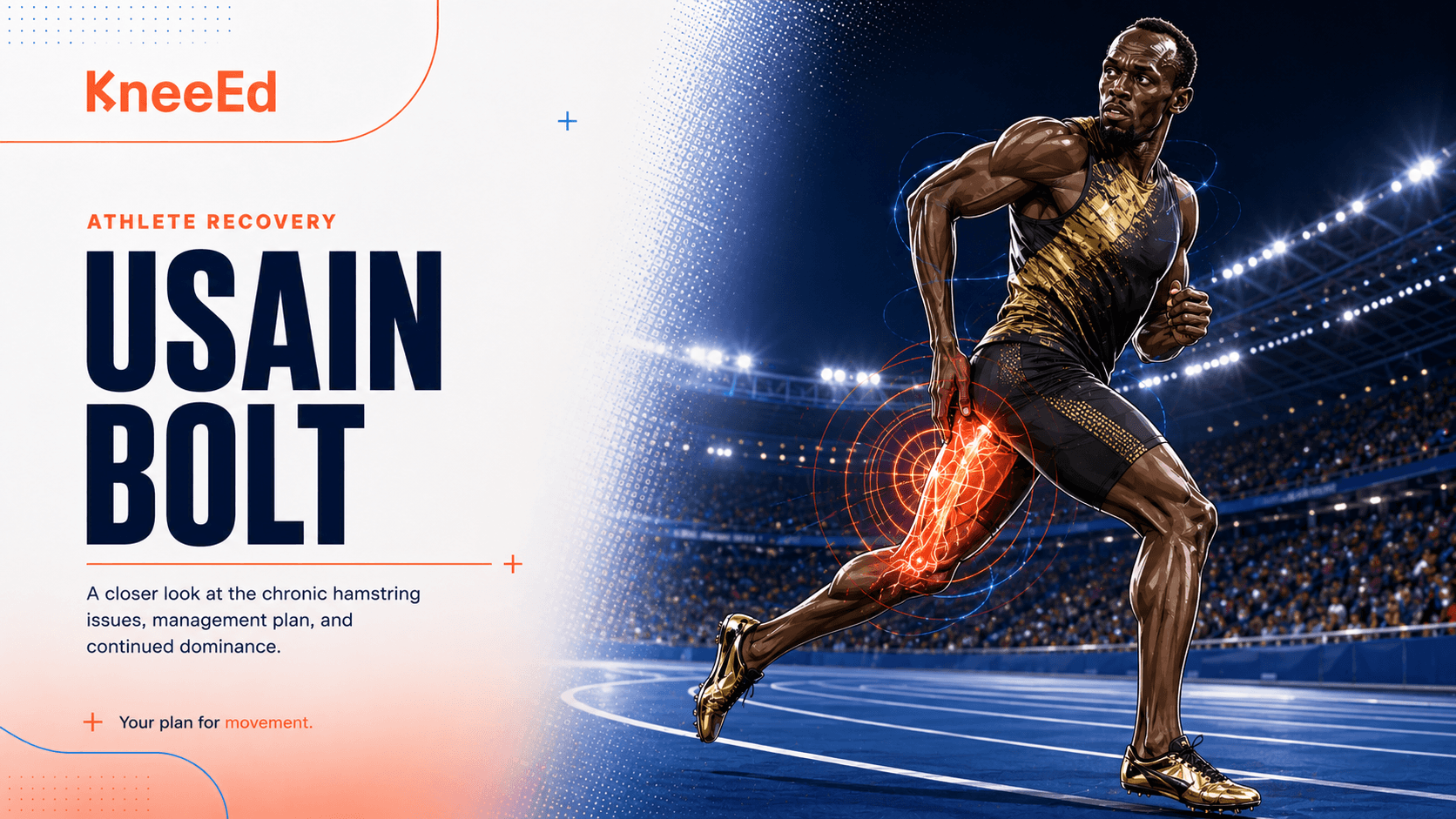
On the night of August 16, 2009, in Berlin, Usain Bolt ran 100 meters in 9.58 seconds. Four days later he ran 200 meters in 19.19. Both are still world records more than fifteen years later, and both are so far ahead of the rest of human history that they read less like times than like errors. He was twenty-two, six feet five inches tall, and built in a way the sport had decided was wrong for sprinting. He won three Olympic golds in Beijing, three in London, two in Rio. For a decade he was not the best sprinter alive. He was the only one in his own category.
What almost no one watching knew was that the body producing those times was, structurally, working against itself on every stride. Bolt's spine curves to the right. The condition is scoliosis, and in his case it pulled his pelvis out of square and left his right leg roughly half an inch shorter than his left. He was not built symmetrically, and a sprinter's hamstring is the muscle that pays for asymmetry. He got injured, by his own account, almost every year of his early career before anyone understood why.
He never corrected the curve. There was no surgery, no cure, no season where the asymmetry went away. What he had instead was a management plan, and the discipline to run it for twenty years until the one race it could not save.
The fastest man, built crooked
Scoliosis is a sideways curvature of the spine, and it is more common than most people realize. In most who have it, it is mild and never costs them anything. In Bolt it was significant enough to be structural, severe enough to shorten one leg, and unlucky enough to land in the body of a man whose profession is the most extreme repetitive loading of the lower body the human race has invented. He was diagnosed in his teens, and in his own plain words the curve was not subtle. It got worse as he grew, the way scoliosis often does through the adolescent growth spurt, and it set the terms for everything that followed.
WhenIwasyoungeritwasn'treallyaproblem.Butyougrowanditgetsworse.Myspine'sreallycurvedbad.ButifIkeepmycoreandbackstrong,thescoliosisdoesn'treallybotherme.SoIdon'thavetoworryaboutitaslongasIworkhard.
Read that quote again, because it is the entire thesis of his career compressed into a few sentences. He does not say the scoliosis went away. He says that as long as he keeps his core and back strong, it does not bother him. That conditional, as long as I work hard, is the whole deal. It is the difference between a structural problem that ends a career and a structural problem that gets raced around. Bolt did not beat his spine. He built a body strong enough to carry it.
What a curve does to a leg
To understand why the hamstring became his chronic weak point, you have to follow the curve downstream. A spine that bows to one side does not stay a back problem. It tilts the pelvis. A tilted pelvis sits unevenly on two legs, which is how a structural curve translates into a functional leg-length difference, in Bolt's case roughly half an inch shorter on the right. From there the asymmetry cascades into the hips, then the thighs, then the hamstrings, and it does so on every single stride. One side of the body is asked to do slightly more work than the other, forever, and at the speeds Bolt ran, slightly more work is an enormous amount of accumulated load.
Biomechanics researchers at Southern Methodist University actually measured this in him, and the numbers are striking. His left leg stayed in contact with the ground about 14 percent longer than his right. His right foot struck the track with a peak force of roughly 1080 pounds, his left with about 955 pounds. The two halves of the fastest runner in history were not running the same race. They were doing different jobs, and the body absorbed that difference somewhere. For Bolt, the somewhere was the hamstring.
The asymmetry, measured. The fastest man alive was not symmetrical, and the numbers show where the load went.
9.58
His 100m world record, set in Berlin in 2009 and unbroken for more than fifteen years.
12 mm
Roughly half an inch, how much shorter his right leg is than his left, a consequence of his rightward spinal curve.
14%
How much longer his left leg stayed in ground contact than his right, per Southern Methodist University biomechanics research.
1080
Peak pounds of force from his right foot at footstrike, versus about 955 from his left. The two sides ran different races.
The management plan: three men and a daily discipline
If the curve was the problem, the answer was never a single intervention. It was a system, run by three key people over more than a decade, and it is worth tracing in detail because the structure of it, not the celebrity of it, is what transfers to anyone managing a chronic vulnerability. The plan had three pillars: fix the mechanics, build the armor, and treat the flare-ups fast.
Glen Mills and the mechanics
Bolt's coach from 2005 until the end was Glen Mills, and Mills's contribution was diagnostic before it was physical. Watching the early Bolt on film, Mills identified a specific biomechanical fault: Bolt was running, in Mills's phrase, behind his center of balance. That sounds abstract until you connect it to the spine. A body already pulled out of alignment by scoliosis, then run slightly behind its own balance point, produces what Mills described as a continual shift of the hip girdle and a pull on the hamstring. The mechanics were amplifying the structural problem. Every stride run out of position was a small tax on the same muscle.
Mills's answer was not a quick cue. It was a roughly two-year technical retraining program, built on video analysis, to rebuild how Bolt carried his hips and core through the stride. This is the unglamorous part of the story that no highlight reel shows: the fastest man in history spent two years deliberately re-teaching his body how to hold itself, because the form he had arrived with was quietly destroying his hamstring. The lesson generalizes cleanly. If your mechanics are feeding your injury, no amount of treatment downstream will outrun them.
Leeroy Gray and the armor
The second pillar was strength, and specifically the core. Leeroy Gray was Bolt's strength and conditioning coach for nine years, responsible for the programs that turned Bolt's own insight, keep the core and back strong and the scoliosis does not bother me, into daily work. The most-repeated number from that work is that Bolt performed up to 700 sit-ups a day. The number is almost a distraction, because the principle behind it matters more than the count: a spine that cannot hold itself in alignment under load needs a muscular corset strong enough to do that job for it. The deep trunk and hip muscles became the stabilizers his skeleton could not be.
This is the single most important and most copyable idea in the whole story. Core stability was not a vanity project or an aesthetic one for Bolt. It was the primary defense against asymmetrical loading. A strong, stable trunk holds the pelvis closer to square, which distributes force more evenly down both legs, which takes load off the hamstring that was being asked to overwork. The strength did not erase the curve. It made the curve survivable at world-record speed.
Hans-Wilhelm Muller-Wohlfahrt and the treatment
The third pillar was the German physician Hans-Wilhelm Muller-Wohlfahrt, who began treating Bolt around 2006, when Bolt was a teenager, and continued to the end of his career. Muller-Wohlfahrt is one of the most famous and most debated names in sports medicine, a Munich-based specialist whose signature approach involves injections, what he calls infiltrations, directly into injured muscle. His preparations have included Actovegin, a substance derived from calf blood, and hyaluronic acid, alongside homeopathic tonics. The science behind some of these is genuinely contested, and it is worth being honest that the evidence is not uniform. What is clear is the relationship. Bolt credited him with resolving a pelvic issue before a major championship and a calf injury before Rio, and dedicated his 2016 Rio 100m gold to him.
Around that treatment relationship sat a fuller recovery apparatus that is more broadly applicable: a masseuse who traveled with the team, regular chiropractic care, consistent physiotherapy with stretches and postural work specific to the scoliosis, and adjuncts like cryotherapy for inflammation. When a hamstring strain did arrive, the rehabilitation leaned on aqua therapy, water running and underwater sprints that let him train the movement while gravity took some of the load off the healing tissue, and on interferential current therapy, electrical stimulation intended to speed tissue repair. Before the 2012 London Olympics, that combination brought him back to win three golds. Before Rio in 2016, a similar protocol turned a Grade 1 strain around in about two weeks.
Theearlypartofmycareer,whenwedidn'treallyknowmuchaboutit,itreallyhamperedmebecauseIgotinjuredeveryyear.
That sentence marks the dividing line. The early Bolt, before the plan existed, was a serially injured athlete: a hamstring problem that cost him the 2004 World Junior Championships, another that forced him out of the 2006 Commonwealth Games, a 2010 season cut short. The condition was the same the whole time. What changed was understanding. Once the team named the root cause, scoliosis driving asymmetry driving hamstring overload, they could finally build a plan aimed at the cause instead of chasing the symptom. The injuries did not vanish, but they stopped defining him.
The science of a scoliotic hamstring
Bolt's case is unusually clean as a teaching example, because the chain from spine to torn muscle is so directly traceable. Understanding that chain is the part of his story that transfers to anyone with scoliosis, a leg-length difference, or simply a recurring hamstring that they have never been able to explain.
Why one side overworks
Scoliosis creates asymmetrical loading of the spine itself, and the muscles around a curve adapt unevenly. On the concave side of the curve, muscles tend to sit shortened and underused, and over years they weaken. On the convex side, muscles are chronically lengthened and overworked, and they tend toward fatigue and tightness. This is not a temporary imbalance that a few sessions fix. It is a structural pattern baked into how the body is shaped, and training can mitigate it but cannot erase it.
That spinal imbalance does not stay in the back. Through the tilted pelvis and the functional leg-length difference, it changes hip alignment and the timing of hip flexion and extension on each side. During the swing phase of sprinting, when the hamstring is working hard to decelerate a fast-moving lower leg, an asymmetrically positioned hip means one hamstring has to work harder than the other to control a limb that is already out of its ideal line. Add the peak demands of maximal-velocity running, and you get localized fatigue and micro-trauma concentrated on the overload side. Repeat that for years and you accumulate scar tissue and a muscle that is chronically closer to its limit than its partner on the other leg.
Why the hamstring, and why sprinting
The hamstring is uniquely exposed in sprinting because it controls two joints at once, the hip and the knee, and it is asked to do so at the exact moments of highest force. There are two danger points on every stride. The first is late in the swing, as the lower leg whips forward and the hamstring contracts while lengthening to slow it down before footstrike, a lengthening-under-load contraction that is the textbook mechanism of a strain. The second is the powerful hip extension as the foot drives off the ground. Both happen at maximal speed, and both ask the most of the muscle at the moment it is most vulnerable. Layer a structural asymmetry on top of that, and you have a muscle running at the edge of its tolerance on one side of the body every time the athlete sprints.
This is why scoliosis makes hamstring vulnerability a lifelong condition rather than a passing one. The weak concave-side stabilizers stay weak. The overworked convex-side muscles stay overworked. The sprint demands peak power at the precise instant of greatest strain. Training narrows the gap; it does not close it. The honest framing, the one Bolt himself lived, is that this is managed, not cured.
How a chronic hamstring actually gets managed
Strip away the calf-blood injections and the traveling masseuse, and what is left of Bolt's plan is a set of principles any motivated person can apply, because they are the same principles the research points to for hamstring resilience and for managing an asymmetry. Prevention and rehabilitation are really the same discipline seen from two sides, and the order of operations matters.
- Obsess over core stability, the right kind. Bolt's insight was the whole game: a strong, stable trunk is the primary hedge against asymmetrical loading. But the goal is deep spinal stability, not just visible abs. Planks, dead-bugs, and bird-dogs that train the deep stabilizers three to five times a week do more for an asymmetric spine than hundreds of sit-ups, because they teach the trunk to hold position under load rather than just flex.
- Train the hamstring to tolerate lengthening under load. Because the injury mechanism is a contraction while the muscle is lengthening, the rehabilitation has to rehearse exactly that. Eccentric exercises, Nordic curls, slow downward-walking lunges, slant-board work, done a couple of times a week and progressed over eight to twelve weeks, are the single best-evidenced tool for building hamstring durability. This is the gold standard, and it is doable at home.
- Correct the mechanics that amplify the asymmetry. This was Glen Mills's entire contribution. Overstriding, an anterior pelvic tilt, a hip that drops on the weak side, all of these turn a structural problem into an injury. Running-form analysis and coaching cues on hip alignment and cadence keep the asymmetry from compounding into a tear.
- Know your weak side and feed it. If you have scoliosis or a leg-length difference, expect the hamstring on the overload side to be your vulnerability, and treat it prophylactically rather than waiting for it to fail. Do the eccentric work on that side, and learn to notice the early pain before it becomes the real thing.
- Respect a graduated return after any strain. Returning to full sprinting too soon re-injures a large fraction of athletes within two years. Walk to jog to sixty percent to eighty percent to competitive speed, testing for pain and symmetry at each gate, is slower and far more durable than rushing the date.
The aqua therapy in Bolt's rehab deserves a specific mention, because it is the cheapest of his tools to copy. Running in water removes much of the gravitational load while still letting the muscle work through its range, which makes it ideal for the awkward early window when a hamstring is too fragile for full-weight sprinting but too valuable to leave idle. A community pool does most of what his underwater training did. The principle, load the movement while sparing the tissue, is the same whether it is bought in Munich or borrowed from a local lap pool.
August 12, 2017: the race the plan could not save
All of it, the two years of retraining, the daily core work, the decade of treatment, bought Bolt one of the longest and most dominant runs in the history of the sport. And then, in his final race, it ran out. At the 2017 World Championships in London, on the anchor leg of the 4x100 meter relay, fifteen steps into his last competitive sprint, his left hamstring failed. He pulled up and went down on the track. It was the literal last thing his career asked of that muscle, and the muscle gave way.
The injury was not a strain in the everyday sense. Bolt, in a rare move, released the medical detail himself, because people had questioned whether he was really hurt. It was a Grade III tear, a complete disruption, of the proximal myotendinous junction of the biceps femoris, with partial retraction. In plain terms: the worst category of hamstring injury, at the worst location, the place where muscle fibers transition into tendon high up near the sitting bone, and the torn end had pulled away from where it should attach. This is the kind of injury that takes four to six months to heal without surgery, longer with, and that is notoriously prone to re-rupture.
Idon'tusuallyreleasemymedicalreporttothepublicbutsadlyIhavesatandlistenedtopeoplequestioningifIwasreallyinjured.Atearoftheproximalmyotendinousjunctionofbicepsfemorisinmylefthamstringwithpartialretraction.
He was prescribed three months of structured rehabilitation. He never raced again. There is a temptation to read the final tear as a failure of the management plan, and that reading is wrong. The plan did not fail. It worked for twenty years against a structural problem that, by definition, was always present and always probabilistic. A muscle running at the edge of its tolerance on one side of the body, year after year, at the highest speeds a human has ever produced, will eventually find the day the edge gives. That the day arrived in his thirty-first year and final race, rather than a decade earlier, is the measure of how well the plan worked, not how badly.
Teens · Jamaica
The diagnosis.
Bolt is diagnosed with scoliosis. His spine curves to the right; his right leg is roughly half an inch shorter than his left. The structural terms of his career are set before it begins.
2004 to 2010 · Unmanaged
Injured almost every year.
Before the root cause is understood, the hamstring fails repeatedly: out of the 2004 World Junior Championships, withdrawn from the 2006 Commonwealth Games, the 2010 season cut short. The condition is consistent; the understanding is not.
2005 onward · Glen Mills
Two years of retraining.
Mills identifies Bolt running behind his center of balance, pulling the hip girdle and the hamstring. A roughly two-year video-led program rebuilds how he carries his core through the stride.
2009 · Berlin
9.58 and 19.19.
Bolt sets both world records within four days. The crooked body produces the two fastest times in human history, records still standing more than fifteen years later.
2011 to 2016 · The plan holds
Core, treatment, repeat.
Daily core work with Leeroy Gray, ongoing treatment with Muller-Wohlfahrt, aqua therapy and electrical stimulation through the strains. Three London golds in 2012; two Rio golds in 2016 after a Grade 1 strain that summer.
Aug 12, 2017 · London
The final tear.
Fifteen steps into the relay anchor, the left hamstring suffers a Grade III tear of the proximal myotendinous junction with partial retraction. The worst hamstring injury, in the last race. Three months of rehab are prescribed; he never competes again.
The honest part: managed is not the same as cured
Here is the part the highlight reels leave out, and the part that matters most if you are reading this with a curved spine or a hamstring that keeps failing. Bolt's career is not a story about beating scoliosis. It is a story about spending twenty years managing something that never went away, with a level of resource, discipline, and biological luck that almost no one reading this will have. He is the outlier, not the template, and treating his outcome as a realistic target is how people get hurt.
Scoliosis is not corrected by exercise. The curve does not reverse, one side stays weaker and tighter than the other, and a serious hamstring tear leaves permanent scar tissue and a real strength deficit even after a full recovery, which is exactly why prevention is so much easier than repair.
Be clear-eyed about the timelines. A Grade III hamstring tear like Bolt's takes four to six months to heal at the most basic level, and six to twelve months to return to competitive sprinting if you were elite to begin with, assuming you do everything right. Many athletes never reach their old speed again. For a recreational runner, a tear of that severity is a major injury: realistically four to six months before pain-free easy running, eight to twelve before sprinting, if sprinting returns at all. The early-mobilization, eccentric-loading approach genuinely speeds healing compared to rest, but it does not rewrite the biology of a fully disrupted muscle.
And scoliosis does not stand still. It can worsen with age as discs degenerate and the curve progresses. Bolt managed his for thirty years through a meticulousness most people will not sustain. The realistic posture for someone living with it is the one Bolt named: the curve is permanent, the asymmetry is permanent, and the daily core work, the periodic physiotherapy, the eccentric strength twice a week, and the awareness of your weak side are not a phase you finish but a discipline you keep indefinitely. Success is not a straight spine. Success is a pain-free life and a hamstring that holds.
Painthresholds,patienceandinnerstrengtharethingsthatcan'tbefoundinarunningmagazine.
There is a mental dimension to chronic management that is easy to undersell. The early years of recurring, unexplained injury were genuinely demoralizing for Bolt; getting hurt every season with no clear reason is its own kind of defeat. The turning point was diagnostic as much as physical. Naming the root cause gave him control, a target, a reason the injuries were happening and a plan to act on. After a Grade III tear, fear of re-injury is real and lasting, and many athletes unconsciously guard the leg when they come back, subtly changing their gait in ways that load the hip or the other knee until something else gives. The patience he points to is not a slogan. It is the actual work of showing up to boring aqua sessions and slow eccentric drills, on a body that will never be symmetrical, for as long as you want to keep moving.
The most useful thing Bolt's hamstring teaches is also the least glamorous. You do not need calf-blood injections or a Munich clinic. You need to find your root cause, build the core that stabilizes your particular asymmetry, train your hamstring to tolerate the lengthening that injures it, fix the mechanics that make it worse, and accept that this is maintenance for life rather than a problem you solve once. The fastest man in history did exactly that, in plainer terms than any clinic would use, and he was honest about its limits. As long as I work hard, it doesn't bother me. Not cured. Managed. That distinction is the whole lesson.
References
- 01EssentiallySports · Olympic legend Usain Bolt admits he never corrected his scoliosis throughout career · Accessed June 2026
- 02SPORTbible · Usain Bolt's curved spine and scoliosis explained · Accessed June 2026
- 03Sports Illustrated · Usain Bolt tears hamstring in World Championships final race (2017) · Accessed June 2026
- 04The Conversation · Usain Bolt and Andre de Grasse: hamstring injuries explained · Accessed June 2026
- 05Speed Endurance · Glen Mills on Usain Bolt and good sprinting technique · Accessed June 2026
- 06Phase IV · Something strange in Usain Bolt's stride (SMU biomechanics) · Accessed June 2026
- 07ESPN Outside the Lines · Hans-Wilhelm Muller-Wohlfahrt: great healer or hyperactive syringe · Accessed June 2026
- 08Medical Daily · Meet Usain Bolt's controversial doctor using homeopathic medicine · Accessed June 2026
- 09AquaCentric · Usain Bolt's aqua therapy and hamstring recovery · Accessed June 2026
- 10Burquitlam Physiotherapy · Usain Bolt's hamstring and keeping him at the Olympics · Accessed June 2026
- 11Kinfolk Wellness · 3 keys to Usain Bolt's success · Accessed June 2026
- 12Scoliosis Reduction Center · With scoliosis, which side is weaker · Accessed June 2026
- 13OrthoInfo (AAOS) · Hamstring muscle injuries · Accessed June 2026
- 14PMC / NCBI · Hamstring strain injury rehabilitation: evidence-based phases · Accessed June 2026
- 15Olympics.com · Usain Bolt: record world champion and fastest man in Olympic history · Accessed June 2026
- 16Wikipedia · Usain Bolt · Accessed June 2026