
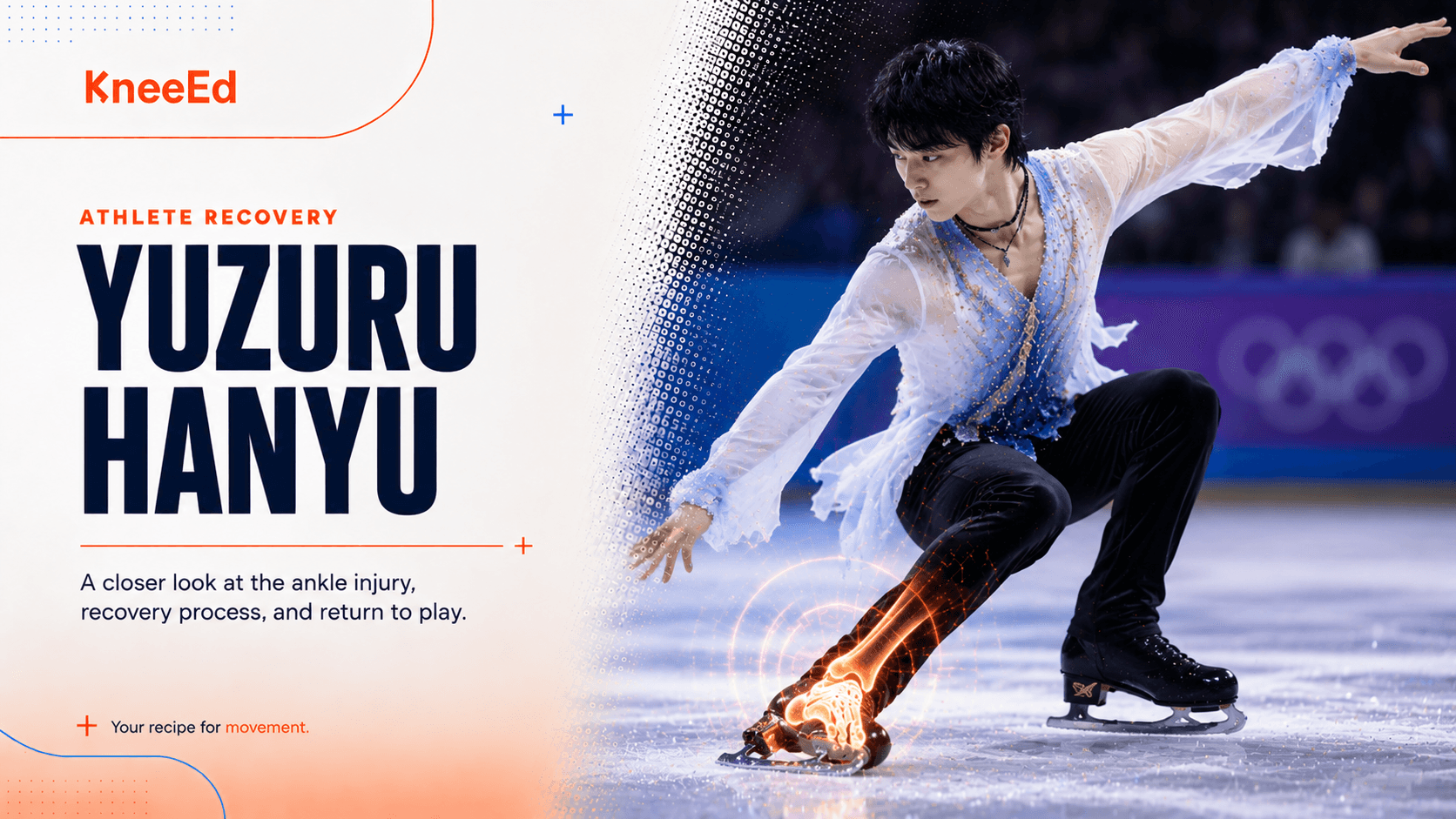
On November 9, 2017, three months before the Winter Olympics, Yuzuru Hanyu came down from a quadruple Lutz in practice at the NHK Trophy in Osaka and landed wrong. By one account he did the equivalent of the splits. The force rolled the foot inward past everything meant to hold it, and the lateral ligaments on the outside of his right ankle gave way. He was the defending Olympic champion and the most artistically gifted figure skater of his generation, and the jump that hurt him is one a skater lands on exactly that ankle, thousands of times a year, with the whole body channeled through a single blade.
He won the gold anyway, becoming the first man in 66 years to win back-to-back Olympic figure skating titles, and he later admitted he could only attempt the jumps because a pain-killing injection had removed the feeling from the ankle.
It is one of the great competitive performances in the history of the sport. It is also, read honestly, a story about what it costs to compete through an injury rather than recover from it. The most useful thing in it is not the medal. It is the bill the ankle kept presenting for years afterward, and what that bill teaches anyone with a sprained ankle and a deadline.
One right ankle, four years, four injuries to the same structure.
66 yrs
Since a man had last won back-to-back Olympic figure skating gold, until Hanyu did it on a torn ankle in 2018.
20-30%
How much the pain had improved from its worst state by the time he competed at PyeongChang, in his own words.
2 mo
He was off the ice before returning weeks before the Olympics, far less than a torn ligament needs to heal.
2
Olympic free skates, in 2018 and 2022, he competed on pain-killing injections and a damaged right ankle.
The jump that lands on the injury
A figure skater's ankle is not like a runner's or a footballer's. Every landing puts the body's full weight, multiplied by the speed of rotation, through one ankle and one thin blade, on ice, hundreds of times a session. The lateral ligaments on the outside of that ankle are the structures that keep it stable through the twisting impact. When Hanyu tore them in November 2017, he had injured the exact tissue his sport asks the most of, on the exact side it lands on.
What actually tore
The Japan Skating Federation's official diagnosis named three things: a right lateral ankle joint ligament injury, a triangular ligament injury, and a right peroneal muscle tendon injury. That is not one structure. It is a cluster, and the cluster is instructive, because it is the classic signature of a severe inversion sprain in a high-load athlete. To understand why it mattered, it helps to name the anatomy that fails in that order.
- The anterior talofibular ligament, or ATFL, runs from the fibula to the neck of the talus. It is the primary restraint against the foot rolling inward, and it is the most commonly sprained ligament in the body. When an ankle goes over, this is almost always the first thing to tear.
- The calcaneofibular ligament, or CFL, runs from the fibula down to the heel bone. It is the second line of defense. It tears when the inversion force keeps going after the ATFL has already failed, which is the mark of a more severe sprain rather than a minor one.
- The peroneal (fibularis) tendons run down the outside of the lower leg and are the ankle's active stabilizers. They fire reflexively to pull the foot back from rolling. When they are injured alongside the ligaments, it signals both a violent mechanism and a higher risk of lingering instability afterward.
A quad Lutz failure delivers all of this at once. The landing creates a sudden inversion force combined with internal rotation and plantarflexion, the foot pointed down and rolling under at the same moment the full rotational load arrives. The ankle travels far beyond its normal range. The ATFL takes the first high strain, the CFL follows if the force continues, and the peroneal tendons cannot react quickly enough to prevent it. On the ice, at speed, on one blade, the margin for the ankle to find a safe position simply is not there.
The medical recommendation was unambiguous: two weeks of complete rest, then roughly three months of rehabilitation. That is the timeline a torn lateral ligament asks for. The Olympics were in February. The arithmetic did not work, and everyone involved knew it.
The real protocol, and where it bent
What Hanyu and his team actually did is worth laying out in order, because the early phase was genuinely sound and the late phase is the cautionary part. The two should not be confused. The off-ice rehabilitation was delegated to Hanyu and a specialized trainer, under head coach Brian Orser at the Toronto Cricket, Skating and Curling Club, with a coaching staff including Tracy Wilson, David Wilson, and Ghislain Briand. Orser later described Hanyu as very smart about his recovery, listening to the physicians and doing proper physiotherapy. The structure was there. The clock was the problem.
- Immobilization and rest. For the first three to four weeks after the November injury, the ankle was protected and offloaded. This is correct and non-negotiable: the acutely torn ligament needs the ends approximated and the swelling controlled before anything else.
- Off-ice rehabilitation. Through December 2017 in Toronto, the work moved off the ice with the specialized trainer, rebuilding range, control, and tolerance away from the impact of skating. This is where the real foundation of an ankle recovery is built.
- A careful, graded return to ice. In January 2018, Orser directed a return that started with stroking, single jumps, and waltz jumps only, with detailed discussions about changing the content of the programs, numerous small goals, and an explicit instruction that Hanyu should not push himself too much.
- Then the compression. From injury to Olympic competition was roughly two months off-ice before February, and the highest-impact element, the quad, was reintroduced under a deadline rather than under a readiness criterion. This is the seam where a defensible rehabilitation became a competition on an unhealed ankle.
PyeongChang, and the injection
Then the ankle gave a preview of the years to come. Hanyu reinjured the same right ankle the day before his free skate at the 2018 Olympics. Minutes before the warm-up, he received a pain-killing injection. He skated, he landed, and he won. Afterward he was unusually, almost clinically honest about why.
Withoutpainkillers,Ican'tlandortakeoffforajump.
He was just as honest about how far from healed the ankle actually was. This is not the language of an athlete who recovered in time. It is the language of an athlete who found a way to compete on an injury that had not recovered at all.
Tobehonest,ifIcomparethesituationofmyanklenowfromtheworsttime,thepainhasonlyimprovedby20to30percent.
What a lateral ankle ligament injury actually needs
Strip away the Olympics and the science of healing this injury is well established, and it is mostly good news. Roughly 80 percent of people recover fully with conservative rehabilitation, no surgery required. But the recovery that works is functional and progressive, not rest-until-it-feels-fine, and the phases follow a clear logic. The point of laying them out is so that the difference between Hanyu's compressed two months and a real timeline is concrete, not abstract.
The four phases, in plain terms
- Acute, roughly days 0 to 10. Protect, control swelling with ice, compression, and elevation, and manage pain conservatively. Gentle range of motion can begin as early as 48 hours, often with simple drills like writing the alphabet with the toe. Functional bracing supports the ankle without locking it rigid. The goal is calm tissue, not a frozen joint.
- Early mobilization, roughly weeks 1 to 4. Progressive weight-bearing inside an external brace, the first proprioceptive retraining (balance and position-sense work), and early peroneal strengthening through eversion. Anti-inflammatories, if used, are for two to three weeks at most. This is where evidence clearly favors movement: early functional management beats prolonged immobilization on nearly every outcome that matters.
- Functional rehabilitation, roughly weeks 4 to 12. Strengthening builds through the peroneals, the intrinsic foot muscles, and the ankle dorsiflexors. Balance work intensifies, on single-leg stances and unstable surfaces. Reaction-time and position-sense drills sharpen the ankle's ability to catch itself. For a skater, controlled, sport-specific loading is reintroduced here, with the brace still on. Maximum benefit tends to land around the ten-week mark.
- Return to sport, roughly week 12 and beyond. Full training resumes under load management, with proprioceptive and strengthening work continuing indefinitely. Sport-specific power, and for a skater the highest-impact jumps, comes back gradually and last, not first.
The evidence underneath these phases is unusually consistent for sports medicine. Early dynamic training shortens return-to-sport time and lowers self-reported reinjury. Balance and proprioceptive training reduces the relative risk of a repeat sprain by a meaningful margin. Prophylactic bracing can cut both first-time and recurrent sprains by up to half. None of this is exotic. It is balance, strength, and patience, applied in order, with the brace and the proprioception carried on well past the point the ankle stops hurting.
What the honest recovery timeline looks like, in a non-competitive body.
3-4 wk
Initial protection and early mobilization before functional rehabilitation truly begins.
8-12 wk
To rebuild functional fitness: strength, balance, and position sense restored in order.
4-6 mo
Minimum before full sport performance, with highest-impact maneuvers later still, around 6 to 9 months.
Lifelong
Proprioceptive work and bracing during sport are ongoing, not a phase you finish and close.
Set that against the real schedule. Hanyu was off-ice for two months, returned to single jumps in January, and was attempting Olympic quads in February. On the honest timeline, the highest-impact maneuvers belong six to nine months out. The injection at PyeongChang did not move him along that timeline. It moved him past the signal that he was not on it yet.
The honest cost, which is the opposite of the legend
Here is the part the highlight reel leaves out. A torn lateral ligament does not fully heal in the way people imagine. It can scar and regain some strength, but a meaningful share of people develop chronic ankle instability within a year, a third still report pain at one year, and a history of sprain is itself the single biggest predictor of the next one. Hanyu's case is almost a textbook illustration of the pattern, played out on the largest possible stage.
Nov 2017
The first tear.
Lateral ligament injury on a quad Lutz at the NHK Trophy. Two weeks rest, three months rehab recommended. The Olympics are three months away.
Feb 2018
Gold on a numbed ankle.
Reinjured the day before the free skate, a pain-killing injection minutes before warm-up, and a win the medical timeline said should not have been possible. By his own account the pain was only 20 to 30 percent better than its worst.
Nov 2021
It happens again.
A third major ankle injury, three months before Beijing, requiring two to three months of treatment. His stated strategy this time was rehabilitation on the ice while controlling pain to shorten the return.
Feb 2022
And again, at the Games.
Reinjured in practice on February 9 attempting the quadruple Axel. A doctor recommended ten days of rest and said it was that bad. He took a pain-killing injection and competed anyway.
2022
The body collects.
He did not recover in time and withdrew from the World Championships. Later he disclosed that surgeons had cut away the damaged parts of a ligament over the years until there was not much of it left.
Why painkillers are the trap, not the tool
Hanyu's honesty is the lesson, and it points in a direction opposite to the legend. The injection did not heal the ligament. It removed the signal the ligament was sending, which is the body's way of saying do not load this. Pain is protective information. Masking it does not change the injury underneath; it only allows more force through tissue that cannot yet take it. Each high-impact landing on a weakened ankle adds microtrauma to the remaining ligament and to the cartilage. The medical literature is plain that this is highly counterproductive to long-term progression, that anti-inflammatories reduce pain and swelling but do not alter the actual course of an ankle sprain, and that continued high-impact loading on a pain-masked joint raises the long-term risk of osteoarthritis.
That last point is not abstract. Roughly 90 percent of ankle osteoarthritis develops after a prior injury, and direct trauma to cartilage during competition can start a progressive, irreversible breakdown of the joint. Hanyu's disclosure is the visible end of that road.
There'snotmuchofthatligamentleft,duetodoctorscuttingthedamagedpartsoutovertheyears.
Read together, the four injuries are not bad luck. They are the predictable arithmetic of competing through rather than recovering from. The same ankle came back, again and again, because the underlying tissue was never given what it needed: time, graded load, proprioceptive retraining, and the discipline to let pain guide the pace instead of being injected away. Hanyu's genius let him win on a compromised ankle twice. It did not let him escape the structural compromise that followed.
What transfers, and what does not
It matters to be precise about what an ordinary person should and should not take from this story, because the temptation is to copy the wrong half.
- Does not transfer: the painkiller decision. Competing on a pain-killing injection is an elite, one-time calculation made with a medical team managing the risk for the single biggest prize in a sport. It is not a recovery strategy, and outside that exact context it is associated with reinjury and joint damage, not heroism.
- Does not transfer: the two-month timeline. An Olympic athlete returning on a compressed schedule is an outlier operating against a fixed external deadline, not a target. Your ligament heals on tissue time, which is months, not the date of an event.
- Transfers: the phased rehabilitation. Protect, mobilize early, rebuild strength and balance in order, brace, and reintroduce impact last. That sequence is the same for a recreational athlete as for a champion.
- Transfers: proprioception and bracing as ongoing habits. The single most evidence-backed way to avoid the recurrent sprain is balance and position-sense training plus prophylactic bracing, carried on well past the point it stops hurting.
- Transfers, above all: the honesty. Hanyu's most sustainable decision was his last one, leaving competition to skate on his own terms and his own schedule, off the scoreboard. Knowing what an injury is asking for and giving it that, rather than borrowing against the joint for a result, is the part worth copying.
The legend is the gold. The lesson is the ankle, and the ankle kept telling the truth long after the medal stopped.
Hanyu is one of the most extraordinary athletes who has ever lived, and the right way to honor that is not to copy the injection. It is to copy the candor. He told us, plainly, that he could not feel the jumps he was landing, that the pain was barely a quarter better than its worst, that if it had been a normal competition he would have withdrawn, and that the ligament itself had been cut away over the years until little remained. That is not a story about willing the body to obey. It is a story about what the body charges when you do. Respect the lateral ankle, rehabilitate it in full, and let the pain set the pace. The ankle you keep is the one you listen to.
References
- 01Olympics.com · Yuzuru Hanyu pulls out of the NHK Trophy after injuring ligaments in his right ankle (2017) · Accessed June 2026
- 02Olympics.com · Relive Hanyu Yuzuru's dramatic PyeongChang 2018 win despite injury · Accessed June 2026
- 03The Japan Times · Yuzuru Hanyu sustains right ankle injury in practice; status unknown for NHK Trophy · Accessed June 2026
- 04Olympics.com · Yuzuru Hanyu expected to have 2 to 3 months of treatment for ankle injury (2021) · Accessed June 2026
- 05Olympics.com · Hanyu Yuzuru withdraws from 2022 World Championships due to injury · Accessed June 2026
- 06Inkl / news wire · Hanyu relied on painkillers to make it through routines, injury-hit skater says · Accessed June 2026
- 07NCBI / PMC · Evidence-based treatment for lateral ankle sprain: functional rehabilitation and the four phases of recovery · Accessed June 2026
- 08NCBI / PMC · Chronic ankle instability, proprioceptive deficit, and reinjury risk after lateral ankle sprain · Accessed June 2026
- 09Precision Hydration / Precision Fuel & Hydration · The risks of athletes using painkillers and NSAIDs · Accessed June 2026
- 10Medscape · Ankle sprain treatment and management: bracing, proprioception, and return to sport · Accessed June 2026
- 11NCBI / PMC · Post-traumatic ankle osteoarthritis: prior injury as the dominant cause of joint degeneration · Accessed June 2026